
- Education
- Tax Institute 2026
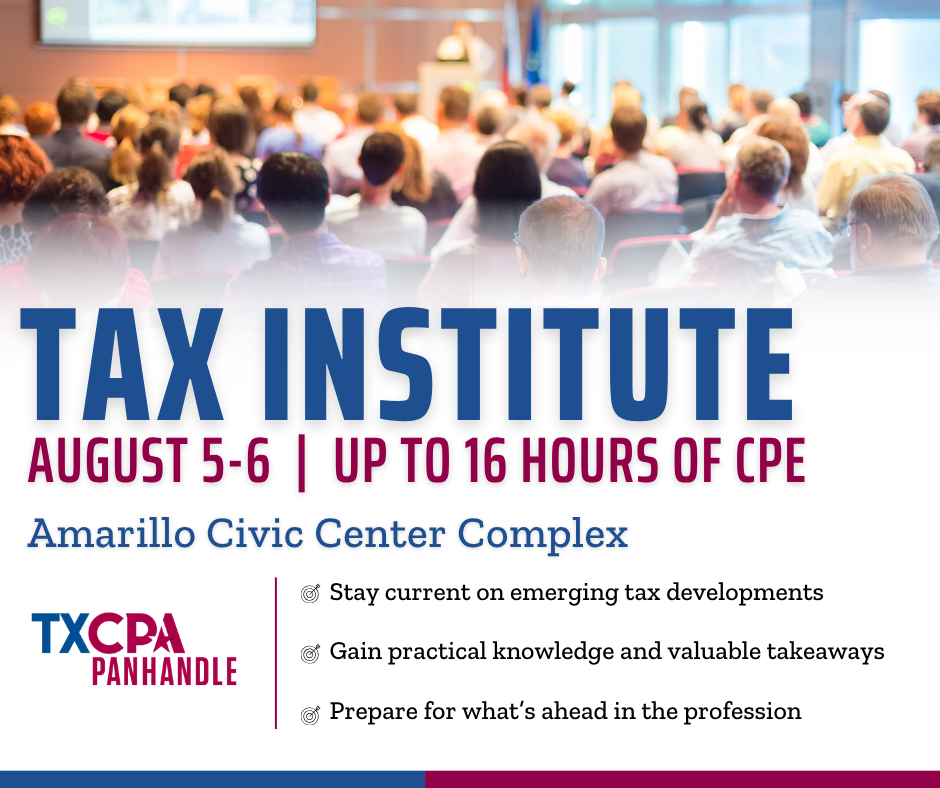
A premier educational event designed to equip CPAs and financial professionals with timely insights, practical strategies, and forward-looking perspectives across today’s evolving tax and business landscape.
Date: August 5-6, 2026
Time: 8:30 a.m. to 4:30 p.m.
Location: Amarillo Civic Center Complex | 401 S Buchanan St. Amarillo, TX 79101
CPE Credits: Up to 16 hours
Price: $275 (both days)/$199 (one day) for members; $325 (both days)/$249 (one day) for nonmembers
2026 TAX INSTITUTE AGENDA:
Tax Institute Day One
-
8:30 a.m. - 4:30 p.m. Federal Tax Update
Speaker: Renee Prince, CPA
Overview: This 8-hour comprehensive course delivers critical updates on federal tax law changes impacting both individuals and businesses for the 2025 tax year. Tailored for CPAs, tax professionals, and accounting advisors, this session focuses on the broad and significant provisions introduced by H.R. 1, including how the legislation reshapes tax planning, compliance, and advisory practices. Attendees will gain actionable insights into new rules, IRS guidance, and court decisions, as well as practical strategies to help clients navigate a rapidly evolving tax environment.
This course is approved for IRS Enrolled Agent continuing education credit under
Program Number DVPYP-U00006-25-I.
This course is approved for State Bar of Texas CLE continuing education credit under
course number 174303632.
Designed For: CPAs and other tax professionals seeking a comprehensive update on recent federal tax law changes and practical guidance on applying new rules, planning strategies, and compliance requirements for individuals and businesses.
Major Topics:
- Overview of H.R. 1: Legislative intent, timeline, and high-level impact
- Changes to individual tax rates, deductions, and credits
- Corporate tax rate adjustments and revised deductions
- Modifications to the Qualified Business Income (QBI) deduction
- Updates to Section 179 expensing and bonus depreciation rules
- Expanded IRS enforcement and increased audit risk areas
- Digital assets: tax treatment and new compliance mandates for individuals and
- businesses
- New and updated tax credits for individuals (e.g., Child Tax Credit) and
- businesses (e.g., R&D, energy incentives)
- Changes to retirement account contributions and distributions
- NOL and business interest expense limitation updates
- IRS guidance on partnership and S corporation reporting
- International tax developments and cross-border compliance considerations
- Tax planning considerations for high-income individuals and closely held
- businesses
Learning Objectives: By the end of this course, participants will be able to:
- Understand the key tax law changes as introduced by H.R. 1
- Identify planning and compliance implications for both individuals and businesses
- Apply new rules and thresholds to tax returns, advisory services, and client
- education
- Navigate increased reporting responsibilities, including those related to digital
- assets
- Evaluate legislative and regulatory trends that may affect future tax strategy
- Advise clients on mitigating risk and leveraging new tax benefits
- Advanced Preparation
- None
- Prerequisites
- Solid foundation in federal taxation for individuals and businesses
- Experience preparing or reviewing tax returns and advising clients
Prerequisites: None
Advanced Preparation: None
Field of Study: Taxes – Technical
Level of Knowledge: Update
CPE Credits: 8.0
Instructional Delivery Method: Group-Live
Tax Institute Day Two
-
8:30 - 9:20 a.m. Estate Planning with Willie Nelson: What an Immortal Can Teach Us About Living and Dying
Speaker: Isreal Miller, CPA, CFP
Overview: This will be an introduction to estate planning in Texas. It will begin with a review of intestacy law in Texas, a review of basic estate planning documents, and finish with planning opportunities to minimize estate and gift tax.
Designed For: CPAs and other tax professionals seeking a foundational understanding of estate planning concepts, including Texas specific considerations, key documents, and strategies for managing and transferring wealth effectively.
Major Topics: Fundamentals of Estate Planning: Benefits of Estate Planning: Understanding why it is important and the advantages of having a plan. Wills and Trusts: Learning about the basic structures and purposes of wills and various types of trusts. Federal Estate Taxation: Identifying the key components and rules of federal estate taxation. Marital Property and Community Property: Understanding how marital property is treated in Texas. Property Inventory: Learning how to properly inventory a client's assets. Practical Strategies and Techniques: Avoiding Probate: Exploring methods to avoid the probate process. Minimizing Taxes: Identifying strategies to minimize gift and estate taxes. Protecting Business Assets: Learning how to protect business assets in an estate plan. Handling Complex Situations: Understanding how to plan for situations involving second marriages, children, or disinheritance. Beneficiary Designations: Learning how to properly name primary, contingent, and residuary beneficiaries. Powers of Appointment and Ascertainable Standards: Understanding how these tools can be used to implement client wishes in a tax-efficient way. Texas Specifics: Texas Probate Laws: Familiarizing oneself with the specific laws and procedures for probate in Texas. Community Property Planning: Understanding the unique considerations and strategies for estate planning in a community property state like Texas. Texas Inheritance Laws: Understanding the rules for inheritance when a person dies without a will.
Learning Objectives: This course will cover the basics of Texas intestacy law, wills, trusts, and tax-saving strategies. The course will also delve into the specifics of community property, covering topics such as marital property treatment, property inventory, and beneficiary designations. Additionally, the course will cover topics such as avoiding probate, minimizing gift and estate taxes, and protecting a client's business assets.
Prerequisites: None
Advanced Preparation: None
Field of Study: Taxes – Technical
Level of Knowledge: Basic
CPE Credits: 1.0
Instructional Delivery Method: Group-Live
-
9:20 - 10:10 a.m. Ethical Decision-Making and Fraud: Understanding the Interaction
Speaker: Steve Dawson, CPA, CFE
Overview: A perpetrator of fraud is often conflicted in the ethical decision-making process. Designed to apply in all areas of client service and/or our own employers, this session introduces the principles and values that define our ethical decisions. It is designed to be interactive through the presentation of a real case study that asks the question, “what would you have done in this situation”. Practical process designs are presented that help an organization guide its workforce in proper ethical decision making to reduce the probabilities of becoming a victim of fraud.
Designed For: CPAs and other tax professionals seeking to strengthen their understanding of ethical decision‑making and its role in preventing fraud, while gaining practical approaches to fostering ethical behavior within organizations.
Major Topics: Difference between ethical PRINCIPLES and ethical VALUES Case Study on the Mind of the Perpetrator Design for Sound Workplace Ethics, including, • Establishing the Foundation Code of Ethics • Modeling Ethical Leadership • Ethics Training
Learning Objectives: The participants will gain an understanding of the differences between ethical PRINCIPLES and ethical VALUES The participants will be presented with information regarding why we must educate our workforces about these differences. The participants will receive practical guidance on how to design an environment of sound workplace ethics.
Prerequisites: None
Advanced Preparation: None
Field of Study: Auditing – Technical
Level of Knowledge: Basic
CPE Credits: 1.0
Instructional Delivery Method: Group-Live
-
10:20 - 11:10 a.m. From Schedule C to Cell Block D: Criminal Tax Enforcement in 2026
Speaker: Michael Villa, Jr.
Overview: Last year was a roller coaster for staffing and organizational shifts at both the Internal Revenue Service and Department of Justice. This presentation will focus on recent IRS enforcement efforts, criminal tax investigations, and cases that have proceeded to court.
Designed For: CPAs and other tax professionals seeking a high-level understanding of current IRS enforcement trends, criminal tax investigations, and the factors driving increased scrutiny in today’s regulatory environment.
Major Topics: IRS Criminal Investigations, tax enforcement, civil tax examinations and audits, criminal tax investigations, IRS and DOJ organization changes and the effect on tax enforcement
Learning Objectives: Learn which IRS Criminal Investigation enforcement areas are a high priority in 2026. Learn how civil tax examinations and audits can escalate into criminal tax investigations. Learn how recent IRS and Department of Justice staffing and organizational changes are shaping criminal tax enforcement strategies.
Prerequisites: None
Advanced Preparation: None
Field of Study: Business Law – Technical
Level of Knowledge: Intermediate
CPE Credits: 1.0
Instructional Delivery Method: Group-Live
-
11:10 a.m. - 12 p.m. Everything is Bigger in the Lone Star State: 2026 Texas Tax Overview of Significant Developments
Speakers: David Colmenero and Alex Pilawski
Overview: True to the spirit of Texas, the 2026 tax year is off to a running start with important developments in Texas tax. Some of these developments may potentially create significant opportunities for taxpayers. You will not want to miss this important overview of recent developments and pending cases that may impact your clients or business.
Designed For: CPAs and other tax professionals seeking a current overview of significant Texas tax developments, including recent legislative, administrative, and judicial changes affecting businesses and taxpayers.
Major Topics: Texas sales and use tax developments, Texas franchise tax developments, recent Texas tax developments and pending cases, Texas taxes
Learning Objectives: Identify significant legislative, administrative, and judicial developments affecting Texas sales and use tax and franchise tax. Analyze recent court decisions and administrative rulings addressing the manufacturing exemption, resale exemption, and other key Texas tax exemptions. Evaluate current controversies involving data processing services, internet-based transactions, and the taxation of digital business activities. Apply recent developments regarding franchise tax apportionment, sourcing, cost of goods sold deductions, and combined reporting requirements.
Prerequisites: None
Advanced Preparation: None
Field of Study: Taxes – Technical
Level of Knowledge: Intermediate
CPE Credits: 1.0
Instructional Delivery Method: Group-Live
-
1 - 1:50 p.m. AI Tools for Modern CPA Practice: Practical Applications, Real Results
Speaker: Chau Tran, CPA
Overview: This session explores the practical integration of Artificial Intelligence within core tax and accounting workflows, moving past high-level market concepts to examine real infrastructure. The presentation dissects the mechanics of confidence-scored transaction categorization engines, merchant-name pattern recognition, and human-in-the-loop exception queues. Additionally, participants will walk through a comprehensive vendor due-diligence framework designed to evaluate data governance, security architectures, and software interfaces against strict regulatory mandates including IRS Section 7216 and the FTC Safeguards Rule.
Designed For: CPAs and other tax professionals seeking a practical understanding of how AI tools can be applied within modern accounting workflows, including considerations for efficiency, data governance, and regulatory compliance.
Major Topics: The Exception-Management Paradigm Shift: Transitioning professional focus from brute-force recording to human-in-the-loop validation, while maintaining SSTS No. 1 oversight responsibilities. Deep-Dive Data Ingestion Mechanics: How a learning-based engine utilizes confidence scoring, merchant-name pattern recognition, and verified vendor history to automate or isolate ledger entries. Asymmetric Workspace Deployment Architecture: Analyzing practical case study layouts (e.g., DynaTax AI) featuring simplified web/PWA client interfaces alongside comprehensive pro dashboards and access-restricted tax research tools. The Professional Vendor Due-Diligence Checklist: A rigorous evaluation framework covering IRS §7216 consent flows, explicit LLM no-training terms, data encryption boundaries, access controls, and sub-processor DPAs.
Learning Objectives: By the conclusion of this session, participants will be able to: Analyze the operational mechanics of the "Exception Management" model and estimate its efficiency gains over manual transaction logging. Differentiate standard rules-based transaction parsing from confidence-scored, learning-based categorization engines. Evaluate third-party AI/application vendors against IRS Section 7216 disclosure rules, the FTC Safeguards Rule, and IRS Publication 4557 by constructing a formal due-diligence checklist. Formulate an internal-control framework for routing low-confidence client data through a structured human-in-the-loop review process
Prerequisites: Basic familiarity with traditional accounting practices, client document collection workflows, and tax compliance procedures.
Advanced Preparation: None
Field of Study: Information Technology – Technical
Level of Knowledge: Intermediate
CPE Credits: 1.0
Instructional Delivery Method: Group-Live
-
1:50 - 2:40 p.m. Send the Elevator Back Down - Precepts in Servant Leadership
Speaker: Josh Willson
Overview: Introduction to the concepts of servant leadership. Leadership that is generated through a desire to serve, prioritizing the growth of others, and earned through trust and care. Instruction is based on the core characteristics of servant leadership: listening, empathy, stewardship and awareness.
Designed For: CPAs and other tax professionals seeking to develop foundational leadership skills by understanding and applying servant leadership principles to build trust, support others, and strengthen organizational effectiveness.
Major Topics: What is Servant Leadership? Core Characteristics Serving Before Leading Power vs. Service Building Healthy Organizations and Modern Applications
Learning Objectives: Understand the characteristics of servant leadership. How does servant leadership contrast most forms of traditional leadership. Learn applications of servant leadership and how they can influence organizations.
Prerequisites: None
Advanced Preparation: None
Field of Study: Personal Development – Non-Technical
Level of Knowledge: All Levels
CPE Credit: 1.0
Instructional Delivery Method: Group-Live
-
2:50 - 3:40 p.m. Business Value Management and the CPA
Speaker: Chris Lucas, CPA/ABV, CFA, CEPA
Overview: One of the greatest benefits of business ownership is the potential to sell the business to fund retirement or transition to the next chapter in the business owner’s career. Unfortunately, few business owners are value motivated. Not because they’re not interested but because they don’t know how. This course will describe how CPAs are naturally equipped to be strategic advisors that guide their clients to business value growth. This discussion is equally relevant to CPAs in public practice and in industry.
Designed For: CPAs and other tax professionals seeking a high‑level understanding of how they can support business owners in building, measuring, and enhancing business value as part of long‑term planning and advisory services.
Major Topics:
- Business valuation
- Forecasting
- Budgeting
- Profit opportunities for CPA firms
Learning Objectives:
- Explore problems in the exit planning industry and explain why CPAs are missing ingredient in the recipe
- Demonstrate the simplicity of helping business owners to become value motivated
- Discuss other key advisors and their roles in the value building process
- Discuss potential benefits to the TXCPA
Prerequisites: None
Advanced Preparation: None
Field of Study: Specialized Knowledge – Technical
Level of Knowledge: Intermediate
CPE Credits: 1.0
Instructional Delivery Method: Group-Live
-
3:40 - 4:30 p.m. Captive Insurance- How Business Owners can Protect their Business, Decrease Taxes and Build Wealth
Speaker: Ken Huffman, CPA
Overview: Captive Insurance is a powerful business strategy that protects a business, decrease taxes and builds wealth. This webinar will provide an overview of captive insurance including: who is eligible; types of policies; how captives integrate with traditional insurance; how to create insurance and warranty programs; structure and formation process; how captives can decrease taxes; costs/benefits; how captives build wealth/ improve cash flow; and case studies of captive insurance companies.
Designed For: CPAs and other tax professionals seeking a high‑level understanding of captive insurance strategies and how they may be used to support business risk management, tax planning, and wealth‑building objectives.
Major Topics: Captive Insurance
Learning Objectives: Participants who successfully complete this course will be able to: • Identify what companies would benefit from having a captive insurance company • Understand the structure and benefits of captive insurance companies • Understand the types of captive insurance policies that are available and how captive policies integrate with their traditional insurance • Understand the cost/benefits and how taxes work within captives
Prerequisites: None
Advanced Preparation: None
Field of Study: Specialized Knowledge – Technical
Level of Knowledge: All Levels
CPE Credits: 1.0
Instructional Delivery Method: Group-Live
Registration Requirements: Pre-registration is required for this event. To register, please visit our website at tx.cpa/panhandle or contact our office at 800.428.0272. Participant credit is given based on actual attendance time. Participant credit is given based on actual attendance time. For live events, late arrivals and/or early departures will be captured manually and notated on the physical sign in sheet or will be captured by the attendance monitoring application.
Refunds and Cancellations: Cancellations received at least 10 business days prior to the start of the event are eligible for a full refund. Cancellations received less than 10 business days prior to the start of the program are subject to a 50% cancellation fee due to facility, food and beverage fees being incurred.
The Texas Society of CPAs is registered with the National Association of State Boards of Accountancy (NASBA) as a sponsor of Continuing Professional Education (CPE) on the National Registry of CPE Sponsors. Boards of Accountancy have final authority on the acceptance of individual courses for CPE credit. Complaints regarding registered sponsors may be submitted to the National Registry of CPE Sponsors through its website: www.nasbaregistry.org.