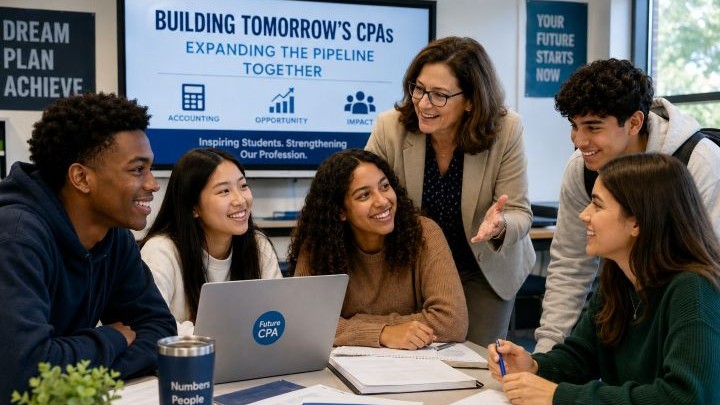
CPA firms, universities and professional organizations are using coordinated efforts to expand the future CPA talent pipeline by reaching students much earlier in the K‑12 system. Because many students choose career pathways as early as 8th grade, the authors emphasize shifting outreach toward freshmen and sophomores already inclined toward business studies.
By Linda Campbell, Ph.D., CPA, CGMA, and Kasey Martin, Ph.D., CPA, CIA
As major efforts remain in place to secure newly minted CPA prospects from statewide college and university accounting graduates, countless statewide accounting firm recruiters, TXCPA members and CPAs in higher education are actively involved in strengthening interest in our profession at the high school level. But expanding the flow into the pipeline is not stopping at the high school level. TXCPA and AICPA continue to call on the profession to collectively reach deeper into the K-12 educational system.
The reasoning behind this push is only growing more intense each year. Across the nation, ninth grade through 12th grade students typically have already chosen their educational path during their College and Career Readiness classes in 8th grade (7th grade in some school districts). This state-funded program helps young Texans to determine which path of study to pursue in high school, starting in 9th grade.
Once in high school, the pipeline of the future is being molded/identified and advanced through the Career Technical Education (CTE) system that reaches not only across Texas, but the entire United States. In Texas today, accounting courses are part of the Business, Marketing and Finance Career cluster, which includes courses such as Accounting and Financial Services. More specific classes such as Accounting I and II are also offered in some school districts as decisions on CTE offered courses are determined at the school district level.
The authors have been personally involved with a highly successful high school outreach program for over a decade, one that has been directly sponsored by their university’s Department of Accounting for 25 years. But several years ago, we noticed the large classes of junior/senior high school students we were reaching were already very well versed in being “college-ready," often having decided on their college degree path and even university of choice well before reaching the end of their junior year. Therefore, reaching out to this group of upper-level high school student was not always the best use of resources of time and sponsorships … our push to introduce them to careers in accounting was already far behind their educational career track choices.
We needed to reach those students much earlier in their high school education, but already pre-disposed to a career in business. We feel this was an effective point to offer outreach and strive to guide their interest, specifically in accounting. We asked our College of Business to let us expand the muti-decade outreach program beyond masses of community college students and upper-level high school students to build a sustainable and successful plan for reaching a younger generation who had already expressed an interest in general business at a minimum. Our plans have been very successful for us – hopefully, our suggested steps and tips will work in your part of Texas.
Steps to Building an Effective CPA Pipeline Program with Area K-12 Educators
We developed a nine-step approach to build an effective pipeline program. Those steps are:
1. Identify your geographic coverage area – a city, a county or a stretch along a major interstate corridor.
2. Learn what CPA organizations (such as your local TXCPA chapter or local firms) are already attempting to build/fill the CPA pipeline in your chosen area and become familiar with what they have already determined to be effective … but do not back off from tweaking an idea they are currently using or that did not work in the past.
3. List the professional organizations already involved in serving/teaching the students most likely to consider a high school study track aligned with a business career. (Do not limit your search to just accounting or finance firms or related industries.)
4. Reach out in person (forget trying to initially reach high school faculty by email/phone) to the faculty leaders/advisors/professional volunteers involved with the clubs and organizations in which the future pipeline candidates are most likely involved, such as Key Club International.
5. Offer to address their Business Programs’ Advisory Meeting or personally invite the schools’ Faculty Career Advisor(s) or an outside Advisory Member in his/her professional office to visit with you. Offer any career advisory assistance they may need, such as classroom lectures on a specific topic, student advisory career discussion sessions, etc. Hint: cyber security, white collar crime detection and "entrepreneurial/start-up" tax issues are currently hot topics!
6. Consider offering a tour (even lunch) of your accounting office or firm; be sure to have several of your new hires present to share their recent educational/career experiences that brought them to accounting as their choice. Hint: let your 1st and 2nd year staff lead the discussion.
7. Whenever possible, include a newer staff member in your visits/presentations! We sought out the advisors of area high schools, accepted invitations to their Advisory Meetings and Annual Business faculty meetings, and often visited one-on-one with a faculty member to customize a presentation and/or our campus/their campus event and quickly realized that including our own students in our visitations and presentations was a major turning point in building our relationships with the high school staff and students. Our Beta Alpha Pi Honors Society, National Association of Black Accountants and Accounting Club students willingly joined in program presentations, and served as mentors and as tour guides whenever asked.
8. Going even further in reaching the target group, identify high school faculty and professionals who were already active in readiness programs and student professional/business organizations, such as serving as competition judges or as non-faculty advisors, and/or mentors.
9. Determine where to find the best potential-future-accounting professional at your area high schools – ask you cohorts, colleagues, anyone with high school age members in their household!
Benefits for Your CPA Firm
Following are some of the benefits for your firm:
1. Improved Recruitment Pipeline - Getting involved and helping to increase the pipeline helps the entire profession! But it also helps your firm directly. Students who have contact with professionals are often more interested in the profession and also the specific firm they have had experience with. When collaborating with high school accounting teachers, the reach is even further, possibly reaching all of their current and future students. These students may be your future applicants, and identifying students who show interest and promise early is always a great idea.
2. Positive Visibility - Volunteering your time with students and teachers increases the visibility of your firm, as well as yourself as a professional. Devoting time to high school students and teachers enhances your community presence and reputation. Students appreciate your time and will remember you and your firm. Strengthening your brand can be helpful when the market for talent gets even more competitive.
3. Contribution to the Business Community - It is a shared responsibility of the profession to keep the pipeline viable for the next generation. Sharing your experiences with students can help them understand the importance of the profession and why it might be a good fit for them. Even students who do not end up in public accounting may become interested in entrepreneurship, finance and leadership, and understand the importance of accounting in all businesses.
4. Relationships with Universities and Professional Organizations - Participating in these types of projects is a terrific way to strengthen connections with universities and professional organizations. Universities will remember your willingness to contribute when they look for their next speaker on campus. Working with professional organizations and universities can lead to partnerships and projects that can also boost your personal network and pipeline as you work towards a common goal together.
5. Insight - Collaborating with the high school community can give you insights and understanding into the next generation of young professionals. Early insight into their scholarly preparation, learning environment and curriculum, as well as understanding the values and what's important to the next group of professionals, is invaluable. Seeing the creativeness and trends of the next generation is impressive.
6. Personal Impact - Sharing your story and path is rewarding in itself and can remind you of why you entered the field and the positive experiences you have had. It is always a nice reminder to look back on the impact you have made while encouraging young students to find a field that is a good fit for them. Giving back to the community in this way is a fulfilling experience. Plus, presenting and practicing leadership at any level can always enhance your presentation and communication skills. You might need to be creative to reach this next generation!
Promoting the Accounting Profession: Outreach That Works - And How You Can Help
Over the past several years, our expanded high school outreach program has demonstrated that meaningful promotion of the accounting profession can be both effective and manageable. Through face-to-face efforts alone, we have reached more than 500 high school students and approximately 50 academic and career advisors and business teachers. These educators have, in turn, carried the message forward to hundreds of additional students within their schools and ISDs.
Our outreach has focused primarily on juniors and seniors, with intentional expansion toward juniors over the past year to reach students earlier in their college decision process. During the academic year, we averaged one high school site visit every six weeks. Engagements varied by school needs and schedules and included:
- Meetings with career advisors;
- Guest presentations at faculty or advisory committee meetings;
- Speaking during business classes; and
- Hosting or staffing information tables in school cafeterias across multiple lunch periods.
In addition to campus visits, outreach faculty recently participated in two full-day conferences, one hosted at a high school located on a military base and another sponsored by a CPA firm for educator and administrator outreach.
The final outreach effort of the academic year involved three separate engagements with juniors at a magnet high school in San Antonio. These included:
- Two on-campus outreach presentations during Entrepreneurial classes (approximately 30 students per class); and
- A half-day campus visit for 35 students and their faculty, which included a presentation and lunch.
In total, we engaged approximately 100 students (mostly juniors), along with faculty members and several career advisors. Eight Texas State accounting students supported these efforts by sharing their academic journeys, career goals and internship experiences, providing a relatable and compelling peer perspective.
Importantly, nearly all outreach activities cost nothing beyond time. Historically, when on-campus lunches were provided, CPA firms generously sponsored basic meals at a modest cost (typically under $20 per student). Career focused brochures and materials are readily available at no charge from professional organizations.
Smaller outreach events are typically handled by one faculty member, while larger or longer sessions often include current students or recent graduates now working in local CPA firms. Their involvement adds a valuable “early career” perspective that resonates strongly with high school students.
The takeaway: a strong outreach program can be scaled to match the time and resources available. Participation can range from a short classroom visit to hosting students at a firm for a half day. Programs can operate at zero cost (excluding time) or include modest expenses such as lunch. Schools consistently provide transportation and chaperones.
We encourage accounting professionals and firms to consider how they might get involved, whether individually or as part of a coordinated effort. Even a small time commitment can have a lasting impact on students’ perceptions of the profession and help strengthen the future pipeline of accounting talent.
Strengthening the CPA Pipeline
The “Pipeline Program” at our College of Business is steadily growing/expanding! But we know it works at the firm level as well. We have been fortunate to be a part of several outstanding CPA firm hosted events for educators and their high school students and look forward to assisting CPA firms any way we can, so reach out in your community – a strong, efficient pipeline is important to our profession.
Millions of dollars are distributed across Texas for CTE programs; however, a 2023 report indicates that 87% of the Texas school districts do not offer a CTE program in a high-wage, high-demand field (Texas Policy, 2024). Meeting with officials within your area school districts, being a part of high school advisory boards, and being proactive in offering to speak at high school business classes and clubs/associations are awesome ways to assist in fueling the CPA Pipeline. REACH OUT!
There are many benefits for the CPA firm, their clients and CPA educators participating in pipeline/outreach programs. Volunteers receive many personal benefits, including experience, networking opportunities and a way to give back to the profession. There is an abundance of resources out there to help you be successful. Get involved today!
Talent and Workforce DevelopmentTXCPA’s Talent and Workforce Development efforts bring educators, CPAs and students together to build a stronger accounting pipeline across Texas. Through statewide initiatives, local chapters and member volunteers, we’re showing students where an accounting career can take them - and how they can get there.
Educators: Inspire What’s Next - You help students see possibilities they may not have considered. TXCPA provides resources, programs and recognition to help you introduce students to the accounting profession and show them the opportunities a CPA career can offer, in the classroom and beyond.
CPAs: Share Your Story - Your experience could inspire someone’s future. Students want to hear from people who have been there. By sharing your career journey, answering questions or participating in an outreach event, you can make the profession more visible, relatable and attainable.
Accounting Opportunities Month - Each year, Accounting Opportunities Month brings the profession into classrooms and communities across Texas. Through events, classroom visits and volunteer-led activities, students get an inside look at accounting careers and the people behind the profession.
Ready-to-Use Resources for CPAs - You don’t have to start from scratch. TXCPA offers CPA pipeline resources, including presentations, classroom tools and volunteer opportunities that make it easy to engage students at every level, from elementary school through college. Together, we can open the door to accounting careers, build a stronger CPA pipeline and inspire the next generation of Texas CPAs.
|
About the Authors: Linda Campbell, Ph.D., CPA, CGMA, is an Associate Professor in the Department of Accounting at Texas State University. Contact her at linda.campbell@txstate.edu. Kasey Martin, Ph.D., CPA, CIA, is an Associate Professor in the Department of Accounting at Texas State University. Contact her at kasey.martin@txstate.edu.


References