A profitable business is not necessarily a valuable or transferable one, as enterprise value depends on organizational architecture rather than dependence on the owner’s involvement. The central message: profitable operations generate income, but only well‑structured businesses build equity that can be sold, transferred or relied upon for retirement.
What CPAs Need to Tell Business Owner Clients Before It’s Too Late
Consider a hypothetical - but entirely representative - illustration. Two business owners, same industry, each generating $3 million in normalized EBITDA. Both have built something real: teams, clients, years of hard work. Yet when each one engages the market, their outcomes diverge dramatically. The first receives an offer of roughly two times EBITDA. The second attracts multiple buyers at five to seven times.
The difference - potentially more than $10 million in enterprise value - is not explained by effort, talent or the income statement. Actual multiples vary by industry, customer concentration, growth profile, and deal structure, but the directional spread between these two outcomes is consistent with lower-middle-market transaction data.1
The gap between them is architecture, specifically whether each business generates income that flows through its owner or has accumulated equity that exists independent of any single person. That distinction is one of the most consequential conversations a CPA can have with a privately held business owner client and the window to have it early enough to matter is often shorter than owners realize.
The Demographic Reality
Recent research estimates that by 2035, roughly six million U.S. small and medium-size businesses will face ownership transition - with peak volume projected between 2028 and 2033.2 The demographic pressure behind that number is real and already underway.
At the same time, the buyer pool has been restructured: private equity, search funds, family offices, and SBA-backed entrepreneurs have moved aggressively into the lower middle market, bringing institutional discipline to every underwriting decision. These buyers underwrite on documented cash flow, operational independence and management depth. What they are buying - or declining to buy - is not a historical income statement. It is the expectation of future performance from an organization that will continue to function without the seller.3
The result is a market with a structural imbalance: an abundance of sellers and a relative shortage of businesses that meet buyer standards for premium valuation. Research from the Exit Planning4 Institute suggests that many owners still lack formal planning infrastructure and only about one-third have taken formal steps to prepare for a sale. Among those who do reach the market, a significant portion discover that what they have built is a profitable operation, but not a transferable asset. McKinsey estimates that a minority of these businesses - in some cases as few as one in six - meet the organizational criteria required to attract a buyer at full value.5
For the owner who spent decades building a multi-million-dollar business, a valuation gap is not a disappointing outcome - it is the elimination of a plan for retirement.
The Income Trap
Most privately held businesses are built around three organizing principles: tax minimization, owner control and operational survival. These are legitimate objectives. None of them is wrong. But when they become the dominant framework for every business decision, they produce a predictable outcome.
The owner becomes the business. Revenue depends on their relationships. Decisions require their judgment. The company cannot operate for two weeks, let alone permanently, without their presence. What appears on the income statement as profit is, in economic terms, largely a return on personal labor, not on a durable institutional asset.
This pattern of owner dependency is one of the most pervasive risk factors in the private business market and one of the most consistently underestimated by owners themselves. It typically manifests in six interconnected ways:
- Revenue tied to personal relationships rather than institutional brand or contracted agreements
- Operational processes undocumented and residing in the owner’s head
- A management team that escalates rather than decides
- Financial records structured for tax minimization rather than accurate economic reporting
- A brand in the market that is functionally the owner’s personal reputation
- Governance structures - if they exist at all - that provide no meaningful independent oversight
Each of these represents a point where enterprise value is not accumulating. Together, they explain why a business that earns well can still be worth very little to anyone other than its current owner.
The trap is compounded by timing. Building the organizational quality required for a premium transaction outcome often takes three to five years or more of consistent, deliberate effort. The business that starts that work at 55 has options. The one that starts at 62 has urgency. The one that never starts has regret. Lower-middle-market transaction data reflects the cost of inaction: valuation spreads between owner-dependent and institutionally prepared businesses - at similar EBITDA levels - can be multiples of annual earnings.6
Where owner dependence is significant, transaction structures can sometimes bridge part of the gap. Extended transition periods, consulting agreements and earnouts tied to post-close performance are common mechanisms buyers use to manage the risk of a business losing its central figure. These structures can preserve a deal that might otherwise fail to close, but they rarely eliminate the valuation discount tied to that risk. The owner typically remains tied to the business well past the closing date and a meaningful portion of the purchase price is contingent on outcomes the seller no longer fully controls.
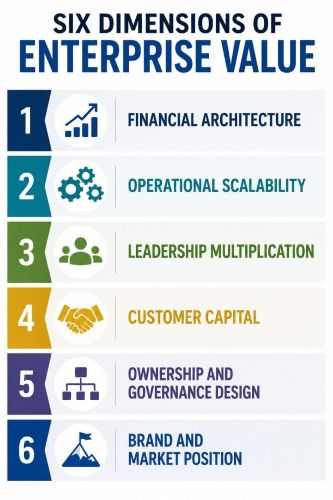
Six Dimensions of Enterprise Value
Six dimensions consistently separate businesses that transfer at full value from those that don’t. Most are strong in one or two, very few in all six.
Financial Architecture. Normalized financials built for transparency, not tax minimization, are foundational - buyers cannot underwrite what they cannot verify and uncertainty is always discounted.
Operational Scalability. Documented processes that produce consistent results regardless of who is implementing them, allowing a business to operate and grow without the owner’s presence at every step.
Leadership Multiplication. A team that makes decisions and develops people without escalating to the owner - the most significant contributor to valuation and the most consistently underdeveloped element in founder-led businesses.
Customer Capital. Revenue that is contractually recurring, distributed across a diversified client base, and tied to the company’s brand rather than to any single person is transferable. Revenue that is not is a risk priced into every offer.
Ownership and Governance Design. Advisory boards, documented authority structures and clear ownership frameworks present far less execution risk to a buyer than governance that lives entirely in the founder’s discretion.
Brand and Market Position. A differentiated market identity that exists independent of the founder’s personal reputation. Companies that can articulate who they serve, why they are different and why that difference is defensible command better clients, better talent and better valuations.
The River and the Reservoir
There is a useful way to think about what separates a business that earns well from one that is genuinely valuable. An income-dependent business is like a river: strong, consistent and immediate in its output. But a river does not accumulate. The moment the conditions that keep it flowing change - the owner steps away, a key client departs, health intervenes - the flow stops. There is no store to draw from.
An equity-building business is like a reservoir. It accumulates from the same flows, but it holds value independently. It can be drawn from, transferred, and passed on. It exists whether the founder is present or not.
Most business owners have spent their careers managing flows. The work of building transferable enterprise value is about building a reservoir alongside the river - not instead of it, not by stopping operations, but by deliberately converting the organizational knowledge, relationships and capabilities that currently exist only in the owner’s head into durable institutional assets.
The CPA’s Opportunity - and Obligation
CPAs remain among the most trusted advisors in a business owner’s orbit and often the ones with the most consistent financial visibility into how the business actually operates. We see the numbers every year. We understand the personal financial picture. We are frequently the first call when something changes.
What we have been slower to do is connect that financial knowledge to the strategic question of enterprise value creation. The advisory infrastructure around most small businesses - accountants, bookkeepers, tax planners - is almost entirely oriented toward optimizing current income. Almost none of it is built to help an owner ask the question that actually determines their long-term financial outcome: Is what I am building transferable?
That question is uncomfortable. It is also essential. And in the current market environment, with transition timelines accelerating and buyer sophistication increasing, it is a question that our clients need us to raise, well before they have decided to sell and long before any transaction is on the horizon.
The businesses that fail to transfer do not just produce smaller numbers at closing. They disappoint the families who sacrificed alongside them and strand the employees who stayed when they could have left.
The conversation does not have to begin with a valuation or a timeline. It can begin with a simple diagnostic question: If you stepped away from this business for 90 days - no calls, no email, no informal approvals - what would break?
The honest answer reveals more about enterprise value than any set of financial statements. And it is the kind of question that, asked early enough, changes what a business ultimately becomes.
The Bottom Line
Profitable is not the same as valuable. That sentence is simple. Its implications are not. For the business owner approaching the back half of their career with the expectation that the business they have built will fund their retirement, support their family and provide options when they are ready for them, it is the most important financial distinction they may never have heard.
CPAs can change that. We have the relationships, the financial visibility and the professional credibility to raise this conversation at the right moment. The owners who benefit most from this work are not those already in a transaction process. They are the ones still in the building phase, with enough time and runway to build something genuinely worth having.
That is the work. And it begins with a question most of them have never been asked.
About the Author: Jeff Beckley, CPA, is the President and owner of Beckley & Associates PLLC, a CPA and advisory firm based in Plano, Texas. The firm works with privately held business owners on financial performance, enterprise value creation and ownership transition readiness. He can be reached at jeff@beckleyassociates.com and by phone at 972-309-0002.

Source Notes
1. IBBA (International Business Brokers Association) (Q3 2025). Market Pulse Report; GF Data (Q2 2025). Middle Market Report. GF Data Resources, LLC; Calder Capital (2024–2025). Lower Middle Market Transaction Reports. The illustrative valuation spread reflects patterns documented across these lower-middle-market transaction sources. Actual multiples vary materially by industry, customer concentration, normalized EBITDA, growth profile, and deal structure.
2. McKinsey Institute for Economic Mobility (2025). U.S. Business Ownership Transition Estimates. McKinsey & Company. Estimates approximately 6 million U.S. businesses will face ownership decisions by 2035, with peak transition volume projected between 2028 and 2033.
3. McKinsey Global Institute (2024). Global Private Markets Review. McKinsey & Company; Preqin (2024). Global Private Equity Report. Preqin Ltd. Total committed but undeployed private capital figures reflect combined estimates across private equity, family offices, and related acquisition capital sources.
4. Exit Planning Institute (EPI) (2023). National State of Owner Readiness Survey. Exit Planning Institute; conducted in partnership with PwC. Research indicates many owners still lack formal planning infrastructure, with approximately one-third having taken formal steps to prepare for a sale.
5. McKinsey Institute for Economic Mobility (2025). U.S. Business Ownership Transition Estimates; Exit Planning Institute and Morgan & Westfield data. McKinsey estimates that a minority of businesses approaching transition by 2035 — in some cases as few as one in six — meet the organizational criteria required to attract a buyer at full value.
6. IBBA Market Pulse Report (Q3 2025); GF Data Middle Market Report (Q2 2025); Calder Capital Lower Middle Market Transaction Reports (2024–2025). Valuation spread data reflects documented transaction multiples for organizationally prepared versus owner-dependent businesses completing transactions in the lower-middle market.
Thanks to the Sponsors of Today's CPA Magazine
This content was made possible by the sponsors of this issue of Today's CPA Magazine:
8amCPACharge
Accounting Biz Brokers
Accounting Practice Sales
Goodman Financial
Rightworks