By Tamara K. Kowalczyk, Ph.D., and Lynn Stallworth, Ph.D.
Businesses face financial risks from environmental, social and governance (ESG) issues, including physical and regulatory impacts from climate change, unsafe labor practices and supply chain threats. ESG risk arises when an environmental, social or governance event or condition could lead to a material loss of investment value due to its negative sustainability impact.
CPAs have an obligation to consider how ESG risks impact the disclosure of material information in the financial reporting process. The traditional definition of materiality focuses on whether an amount is significant enough to influence the decisions of financial statement users. SEC guidance provides that an issue is material if there is a “substantial likelihood that a reasonable investor would consider it important.”
In assessing ESG risk, the double-materiality perspective extends this definition to also consider the social impact of the company’s activities.
Identifying Material ESG Risks
ESG risk assessment focuses on identifying non-financial factors that could pose “material” financial cost or loss. Assessing the materiality of these risks requires evaluating both the magnitude and likelihood of their financial impact, as well as the extent to which they could influence decision-making by investors and other stakeholders. Because formal guidance is still evolving, disclosure of material ESG risks remains inconsistent and potentially underreported, especially when financial impacts are uncertain.
Frameworks such as the Sustainability Accounting Standards Board (SASB) standards and the European Sustainability Reporting Standards (ESRS) help identify material topics. The SASB Materiality Finder is an online tool that allows users to look up the sustainability topics SASB has identified as likely to be financially material for a specific industry, along with the related disclosure metrics.
The ESRS provides a structured list of ESG topics and subtopics that companies can use as a starting point for identifying which issues are likely to be material under a double-materiality assessment. CPAs can use this guidance to analyze which non-financial ESG factors may lead to financial impacts, even if those impacts cannot yet be precisely quantified.
Assessing the Materiality of ESG Risks
Sustainability reporting has traditionally focused on how a company's operations impact the environment and society. ESG risk assessment, however, emphasizes how these impacts can pose material financial risk to a company. A new concept known as double materiality considers both perspectives by evaluating the company's impacts on society and the financial impact of ESG risks on the business.
The concept of double materiality, depicted in Figure 1, was introduced in the European Union’s Corporate Sustainability Reporting Directive (CSRD), which focuses not only on company impacts on environmental and social resources (Impact materiality) but also on how threats to these resources create risk for the company (Financial materiality). By adopting this two-sided perspective, a company can more effectively manage and mitigate both imposed and sustained negative impacts.
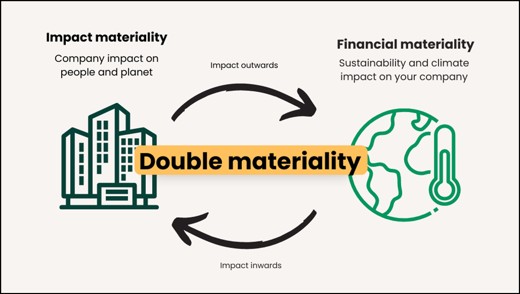
Figure 1. Double Materiality Concept
Source: Worldfavor (2024), “CSRD: What is the Double Materiality Assessment,” Worldfavor Blog.
Recognizing that double materiality extends the traditional concept of materiality helps accountants integrate material ESG issues into familiar reporting and assurance frameworks.
Using ESRS Topics as a Reference. The ESRS guidance specifies topics to consider in a double materiality assessment. The environmental, social and governance topics and subtopics are summarized in Table 1.
| Table 1. ESRS Topics for Materiality Assessment | |
| ESRS Code and Topic | Example Subtopics |
| E1 – Climate Change | GHG emissions, energy use and impact mitigation |
| E2 – Pollution | Air, water and waste pollution and prevention |
| E3 – Water/Marine Resources | Water use and conservation, ecosystem protection |
| E4 – Biodiversity and Ecosystems | Land use, species protection, restoration |
| E5 – Resource Use and Circularity | Material efficiency, waste reduction |
| S1 – Own Workforce | Pay equity, worker well-being, diversity, and training |
| S2 – Workers in the Value Chain | Suppliers’ labor practices, due diligence and fair treatment |
| S3 – Affected Communities | Community well-being, indigenous rights, local economy |
| S4 – Consumers and End Users | Product safety, cybersecurity and customer access |
| G1 – Business Conduct | Ethics, compliance, anti-corruption, governance |
Source: EFRAG, ESRS Set 1, Application Requirement (AR) 16
CPAs can use these topics, in addition to the material issues identified through SASB’s Materiality Finder for U.S. companies, to help identify and prioritize ESG factors that are material from both an outside-in financial risk perspective and an inside-out impact risk perspective.
Performing a Materiality Assessment
Once relevant ESG topics have been identified, CPAs can use the following structured process to determine which are material for financial reporting.
Step One: Define the scope and objectives. Clarify why the assessment is being performed. Is the purpose to support double materiality reporting, anticipated SEC climate or ESG disclosures, lender due diligence, or a voluntary sustainability report?
Step Two: Identify and refine ESG topics. Use the ESRS topic and subtopic list as a starting point or to further refine the primary ESG factors indicated for the company’s industry in the SASB Materiality Finder. The objective is to identify the full scope of issues that potentially give rise to financial risk or significant external impacts.
Step Three: Engage management and stakeholders. Hold discussions with management, board members and other stakeholders, including employee, investor and community representatives, to explore ESG issues already influencing decision-making and topics perceived as most urgent.
Step Four: Assess likelihood and magnitude. Evaluate both the likelihood that each topic will create a risk and the potential magnitude of the effects using risk-ranking tools, such as low/medium/high scales or scoring matrices, to standardize these judgments.
Step Five: Prioritize and visualize results. Plot the topics on a double-materiality matrix, with impact on people and the environment on one axis and financial effects on the company on the other. This helps identify which require greater consideration for measurement and disclosure.
Step Six: Document, review and support disclosure. Document the criteria applied, data used, stakeholder input considered, and the rationale for the final decisions regarding materiality to provide the basis for disclosures explaining how material ESG topics were determined under both financial and impact perspectives.
Example: ABC Beverage Company
Relevant ESG topics should reflect the impacts both on and by the company. Table 2 provides an example for the fictitious ABC Beverage Company that illustrates the use of these topics to assess both Impact materiality and Financial materiality.
Focusing on the ESRS topics identified, the company identified Water Use (E3) and Packaging Waste (E5) as material issues. Water scarcity emerged as both an operational issue and a community concern: the company relied on local water sources to operate its bottling lines, and droughts had already led to production slowdowns and tensions with nearby residents and farmers. Packaging was a source of brand and regulatory risk, as rising public concern about plastic waste and new state recycling rules increased the risk of reputational damage and higher compliance costs.
| Table 2. Example of Double Materiality Assessment for Beverage Company | |
| Impact Materiality | Financial Materiality |
| E3: Overuse of water sources can cause shortages for personal use | E3: Water shortages can threaten production supply and disrupt operations |
| S3: Air and water pollution from production processes can threaten health and wellbeing of local residents and workers | S3: Threats to reputation of company related to causing damage to health of workers and local residents |
| S2: Suboptimal worker conditions in underdeveloped countries | E5: Ban on use of certain plastics can increase costs of packaging options (e.g., plant-based plastic) |
| E5: Use of plastic bottles contributes to ocean waste | E1: High GHG emissions can deter ESG investors |
Source: Author developed
Mapping ESG Risks
A double materiality matrix is a helpful tool for prioritizing risks based on higher-impact materiality, financial materiality, or both. The graph in Figure 2 shows a map of material topics for ABC Beverage Company. Topics to include were identified by the SASB Materiality Finder for the beverage industry and relevant items from the ESRS topic list. SASB topics include GHG emissions and energy use, water and wastewater management, product safety, responsible marketing, and responsible supply chain management. Additional ESRS subtopics include community water access, customer privacy, corporate ethics, and sustainable packaging.
In Figure 2, impact materiality is mapped on the x-axis and financial materiality on the y-axis, with each quadrant representing different levels of priority (low to high). For example, the upper-left quadrant indicates that Community Water Access is a high-priority societal impact. In contrast, Worker Safety in the lower-right quadrant is a highly prioritized financial risk to external stakeholders. The upper-right quadrant indicates that Water Stewardship, Sustainable Packaging, and Wastewater Management are high-priority risks for both materiality types.
For CPAs, the double materiality matrix serves a role like that of audit risk tools. It provides a clear visual of the ESG topics for which both financial exposure and stakeholder concern are high.
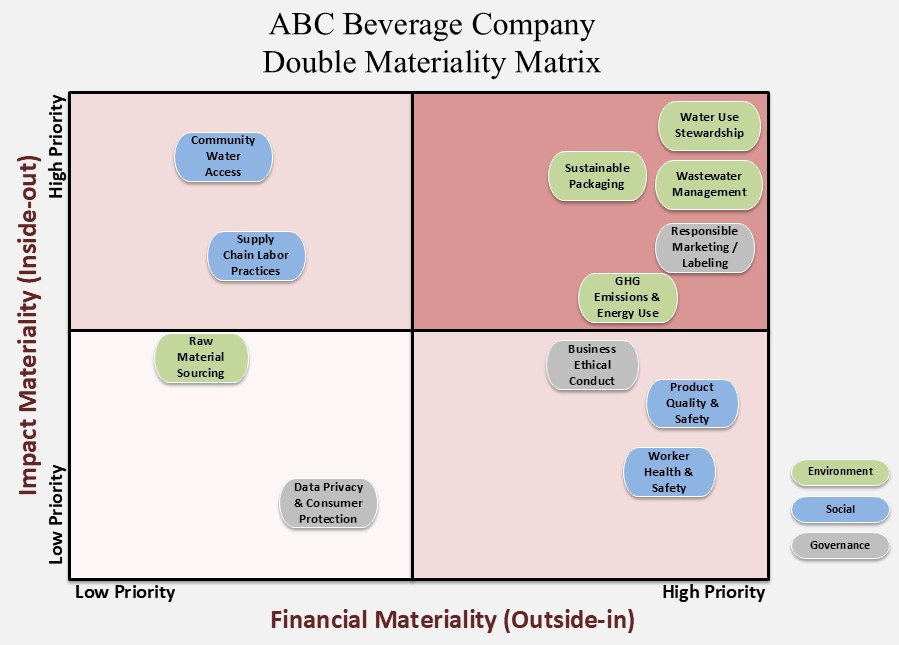
Figure 2. Example Double Materiality Matrix Tool
Source: Author developed
Disclosing ESG Risks
ESG risks identified as financially material should be reported in Form 10-K, generally in the MD&A discussion, and disclose the impact on the firm’s financial position or future cash flows. Broader impacts on society and the environment, along with related performance metrics, are usually addressed in a separate sustainability report. ESG risks should also be documented in internal risk registers and other supporting materials for assurance purposes. Proper cross-referencing and alignment ensure CPAs can demonstrate consistent evaluation of ESG risks across financial reporting, governance and sustainability communications.
The following are sample disclosures of financial materiality in the MD&A and impact materiality disclosure in a sustainability report for ABC Beverage Company:
Water Scarcity. Several production facilities operate in regions experiencing increasing water scarcity. Reduced water availability for industrial withdrawals could limit production capacity, increase input costs or require capital expenditures for water-efficiency technologies.
Community Water Impact. As we depend on reliable water supplies, we assess how our operations affect local water availability in high-risk regions and increase pressure on community watersheds used for household and agricultural use. With local partners, we conduct shared-water assessments and implement conservation projects to support long-term community water security.
While quantifying financial estimates of ESG risk is challenging, uncertainty does not exempt from the obligation to disclose. CPAs can assist companies that must disclose, at least qualitatively, whether certain ESG factors could pose material financial risks and what they are doing to mitigate those risks.
Integrating ESG Risks into Financial Materiality Assessments
ESG risks are no longer tangential issues reserved for separate sustainability reports. These risks increasingly affect key questions that CPAs already address – how they could impact cash flows and which uncertainties are most relevant to investors and lenders.
The double materiality framework provides practitioners with a structured way to connect the financial implications of environmental and social impacts. Even when monetary estimates are uncertain, CPAs can use a double materiality assessment as a foundation for well-supported qualitative disclosures of material ESG risks.
About the Authors: Tamara K. Kowalczyk, Ph.D., is Professor of Accounting at Appalachian State University. Contact her at kowalczykt@appstate.edu. Lynn Stallworth, Ph.D., is a Professor of Accounting at Appalachian State University. Contact her at stallworthhl@appstate.edu.


Related CPE
ESG 101: What is Environmental, Social and Governance? The Controllership Series: The Role of the Controller in ESG Common Sense CFO: Decoding and Mitigating Internal and External Risks To learn more and register, click here and search on the program title.
|
References