July 03, 2025
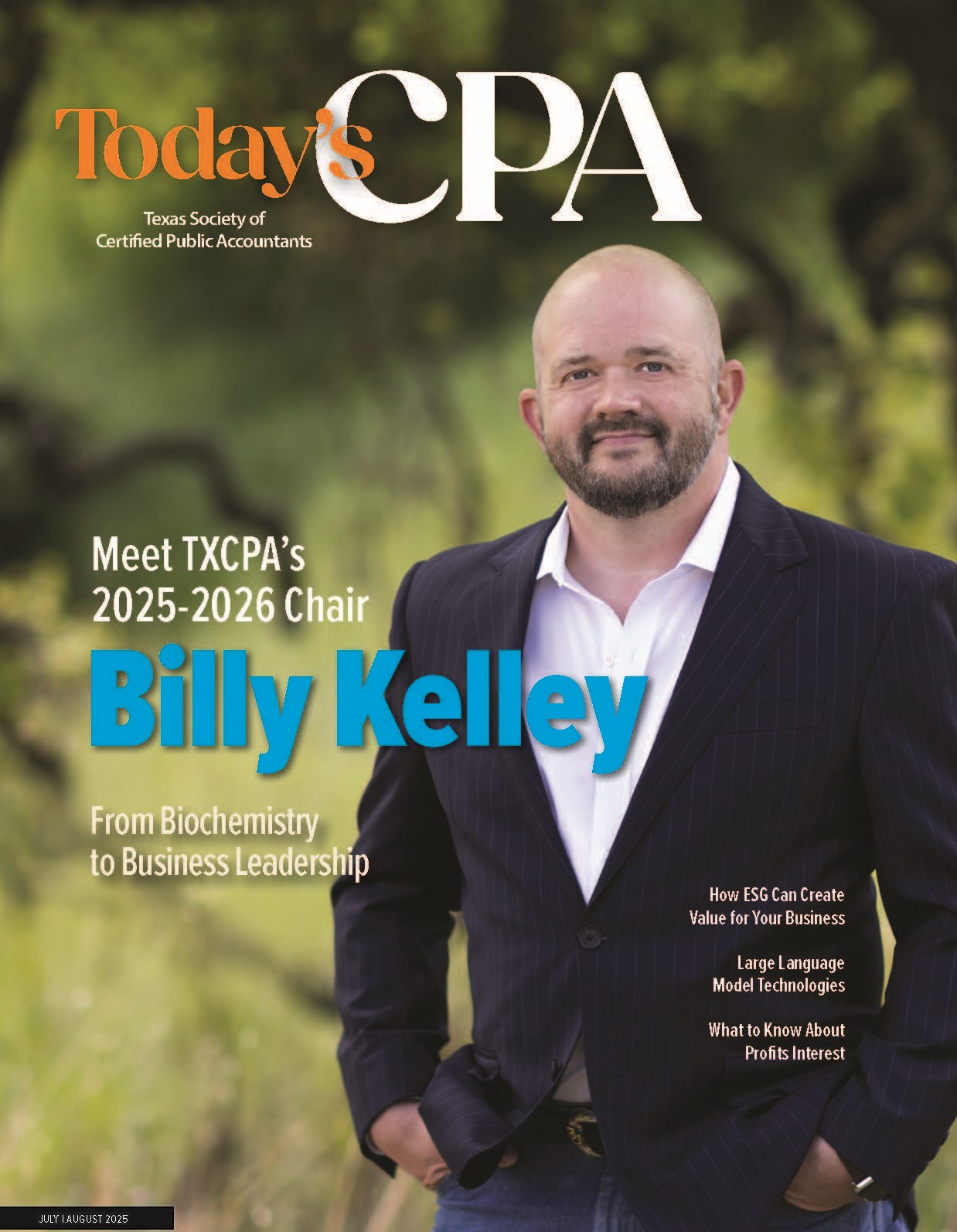
How ESG Can Create Value for Your Business



By Derrick Bonyuet, Ph.D., CFA, CFP, CPA
The Securities and Exchange Commission (SEC) has implemented reporting requirements to enhance public company disclosures regarding risks and impact of climate-related issues. The purpose of these rules was to provide investors with consistent and reliable information to support their investment decision making. However, the rules also faced intense criticism from corporations and some lawmakers.
Rather than seeing environmental, social and governance (ESG) as a reporting compliance standard, this article seeks to educate users on how ESG can create value for their business.
Background
Any business is deeply interconnected with ESG matters. To understand this statement, let’s review each of these elements:
- The environmental aspect encompasses the energy consumption and waste generation by the company, the resources required, and any resultant impact from its operations.
- The social aspect denotes the relationship between the company and the communities in which it operates, including labor relations and diversity.
- Governance pertains to the internal systems, controls and procedures a company implements to operate efficiently, comply with regulations and meet the expectations of external stakeholders.
As businesses are influenced by these elements, management can take proactive steps to support a strong ESG framework that can provide value and long-term sustainable success.
Where is the Value Coming From?
Regardless of a company’s industry, value can be extracted with a strong ESG proposition. The following areas allow management to understand where value can be derived.
Improved company reputation: By maintaining consistent and transparent communication about their ESG initiatives, companies can present themselves as ethical and responsible. This builds trust with stakeholders and increases brand value. Furthermore, higher brand value is likely to be reflected in increased stock prices, as studies have shown a positive correlation between brand valuation and stock prices1.
Revenue growth: A robust ESG proposition can project an image of "good corporate citizenship," enabling the company to access new markets and opportunities. Governments and other organizations may be more inclined to offer partnerships, licenses, resources, and contracts to companies that demonstrate responsible stewardship. Additionally, consumers prioritize sustainability, as evidenced by a joint study from McKinsey and NielsenIQ, which found that products with ESG-related claims saw a 28% cumulative growth over five years, compared to 20% for products without such claims2.
Cost savings: By integrating ESG commitments into their business models, companies can foster innovation and operational efficiencies. Strategies can lead to reduced operating costs through decreased raw material consumption, water usage and carbon footprint. For example, adopting paperless processes, using recycled materials, optimizing waste management, and implementing energy-efficient upgrades can enhance ROI and boost the bottom line.
Fewer regulatory and legal interventions: A robust ESG proposition can offer companies greater operational freedom by potentially lowering regulatory scrutiny. Companies committed to ESG are often viewed as responsible actors in the business environment, reducing the risk of adverse government actions3. This may have huge implications for the business, as up to one-third of corporate profits might be susceptible to state intervention4.
Increased employee productivity: Employees, particularly younger ones, are often drawn to companies that demonstrate a positive social impact. A strong ESG proposition can help attract and retain talent, boost employee motivation and enhance productivity. Studies have shown that a positive social impact correlates with higher job satisfaction5. Moreover, employee satisfaction has been positively linked to shareholder returns, with Edmans6 finding that companies on Fortune’s “100 Best Companies to Work For” list generated 2.3% to 3.8% higher stock returns than their peers.
Investment and asset optimization: A strong ESG proposition can lead to the allocation of resources towards more promising and sustainable opportunities, such as renewable energy and waste reduction7. Additionally, considering environmental factors and their long-term impact on assets is crucial. Consequently, assets may need to be proactively repurposed to address future challenges. This approach results in improved long-term investment decisions.
Greater access to capital: A strong and well implemented ESG proposition may attract more investors and financial institutions. Studies have shown that almost 80% of investors now consider ESG risks when making investment decisions8.
How Can We Measure the Benefits?
Measuring the benefits of ESG efforts can be challenging, as the field continues to evolve. There are many ways to associate specific initiatives with financial value and no single agreed-upon methodology exists for assessing the impact. However, there are different frameworks available, such as:
- Global Reporting Initiative (GRI): A widely used framework for sustainability reporting.
- Sustainability Accounting Standards Board (SASB): Standards for reporting on sustainability in SEC filings.
- Task Force on Climate-related Financial Disclosures (TCFD): Recommendations for disclosing climate-related risks.
- United Nations Sustainable Development Goals (SDGs): Aligning ESG efforts with global sustainability goals.
Once a framework has been selected, management must focus on the company’s operations and identify relevant KPIs to track across the different ESG elements. Examples include the following elements.
Environmental
- Carbon Footprint: Total greenhouse gas emissions.
- Energy Consumption: Total energy usage and the proportion from renewable sources.
- Water Usage: Total water consumption and water recycling rates.
- Waste Management: Amount of waste produced, recycled and properly disposed of.
- Biodiversity Impact: Effects on local ecosystems and efforts to mitigate biodiversity loss.
Social
- Labor Practices: Employee turnover rate and employee satisfaction scores.
- Health and Safety: Workplace accident rates and health and safety initiatives.
- Community Engagement: Investments in community projects and corporate social responsibility (CSR) activities.
- Human Rights: Policies and practices regarding human rights in operations and supply chains.
Governance
- Executive Compensation: Alignment of executive pay with long-term company performance.
- Ethics and Compliance: Incidents of corruption, bribery and adherence to ethical guidelines.
- Transparency: Quality and frequency of ESG disclosures and reporting.
Next, management must ensure an integrated and rigorous reporting process is implemented across the whole organization. An integrated report will provide a more complete story of how efforts are impacting different segments and silos, along with meaningful insights into how value is created.
A rigorous ESG report will focus on a sustainable process built on exceptional data quality. This reporting process must include comparisons to benchmarks based on peer data and industry averages, as well as ratings from third-party agencies to assess relative performance.
Last, a feedback loop process must be in place to enable continuous improvement of ESG practices and metrics.
Driving ESG Success Through Effective Implementation
There is no doubt a strong ESG proposition can create value for a business. However, ESG activities must be well implemented and reporting the results can be a challenging task.
That’s why it’s imperative for management to embrace ESG by creating cross-functional committees supported by executives from different parts of the business. An ESG roadmap must be defined and communicated to all members of the organization to ensure alignment and commitment from all employees.
 About the Author: Derrick Bonyuet, Ph.D., CFA, CFP, CPA, is a clinical assistant professor of accounting in the McCombs School of Business at The University of Texas at Austin. He teaches Intermediate Accounting and Financial Statement Analysis. He is currently serving as the acting CFO of Hazel Aero, an early-stage startup working to design the new generation of search-and-rescue aircraft. Contact him at derrick.bonyuet@gmail.com.
Footnotes
1. Kirk, C., Ray, I., and Wilson, B. (2013). “The impact of brand value on firm valuation: The moderating influence of firm type.” Journal of Brand Management (2013) 20, 488 – 500. doi:10.1057/bm.2012.55
2. Frey, S., Bar Am, J., Doshi, V., Malik A., and Noble S. (2023). “Consumers care about sustainability – and back it up with their wallets.” McKinsey Insights. https://www.mckinsey.com/industries/consumer-packaged-goods/our-insights/consumers-care-about-sustainability-and-back-it-up-with-their-wallets
3. Bannier, C., Bofinger, Y., and Rock, B. (2019). Doing safe by doing good: ESG investing and corporate social responsibility in the U.S. and Europe, CFS Working Paper Series, No. 621, Center for Financial Studies, https://nbn-resolving.de/urn:nbn:de:hebis:30:3-480587
4. Henisz, W., Koller, T., and Nuttall, R. (2019). “Five ways that ESG creates value.” McKinsey Quarterly. https://www.mckinsey.com/~/media/McKinsey/Business%20Functions/Strategy%20and%20Corporate%20Finance/Our%20Insights/Five%20ways%20that%20ESG%20creates%20value/Five-ways-that-ESG-creates-value.ashx
5. Henisz, Koller, and Nuttall, 2019.
6. Edmans, A. (2013). “Does the Stock Market Fully Value Intangibles? Employee Satisfaction and Equity Prices.” Journal of Financial Economics. 101(3), 621-640. https://ssrn.com/abstract=985735
7. Boffo, R., and R. Patalano (2020), ESG Investing: Practices, Progress and Challenges, OECD Paris, www.oecd.org/finance/ESG-Investing-Practices-Progress-and-Challenges.pdf
8. Chalmers, J., Cox, E., and Picard, N. (2021). “The economic realities of ESG.” Strategy+Business. www.pwc.com/economic-realities-of-ESG
Thanks to the Sponsors of Today's CPA Magazine
This content was made possible by the sponsors of this issue of Today's CPA Magazine: