Are You Career Ready?




Competencies to Succeed in an Accounting Career
By Dan W. Royer, Kelsey R. Brasel, Amy J. Moudy, and Tiffany J. Westfall
Readiness for an accounting career demands a skill set beyond the material taught from a textbook in the typical undergraduate accounting programs. Mastery of task-oriented and intellectually focused accounting skills is essential to becoming a CPA and obtaining a desirable position.
However, based on our professional experience, interacting well with others, demonstrating a willingness to learn and exhibiting a strong work ethic can be equally important to a new hire’s professional reputation.
These skills are often labeled “soft skills.” In this article, we assert these skills are more than soft skills; rather, they are key indicators of career readiness and predictors of a successful transition into the workplace for recent college graduates.
The National Association of Colleges and Employers (NACE) discusses career readiness as the development of specific skills beyond the highly specialized content knowledge obtained in college (Career Readiness for the New College Graduate: A Definition and Competencies, National Association of Colleges and Employers, www.naceweb.org, 2017). This skill development aligns with best practices identified in the research and improves graduates’ transition to the workplace.
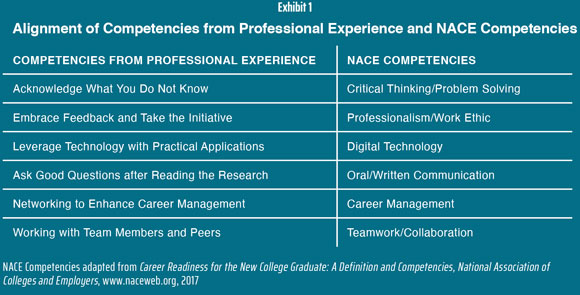
We align the NACE competencies for career readiness with best practices based on our professional accounting experience and research that describes important skill development during the first two years on the job (see Exhibit 1).
The ability to persist through the hard work of earning an accounting degree or CPA license is a significant accomplishment. However, this accomplishment means you now possess the credential and minimum knowledge required to begin a career in accounting.
Researchers describe the importance of specific qualities during the first two years of employment that include:
- Showing a desire to learn;
- Being a team player; and
- Volunteering for new assignments.
Interestingly, demonstration of technical skills was among the qualities least mentioned¹.
We argue, and research confirms, that the most successful college graduates pursuing a career in accounting recognize the importance of asking good questions. Recognizing the need to learn is not only a best practice, but also a crucial element of the competency of critical thinking and problem-solving².
Acknowledge What You Do Not Know (Critical Thinking/Problem Solving)
The willingness to learn is a critical element in the process of critical thinking. Central to this competency is the ability to obtain, interpret and use knowledge to analyze problems. Among the qualities of the most successful college students and recent graduates prepared for a career in accounting is the willingness to acknowledge they are not the ones with the answers. Rather, they should be focusing on asking good questions that lead to the development of resources for future reference.
Effective questions include seeking career guidance from experienced staff and assigned mentors, understanding priorities dictated by the engagement and the firm, and identifying specific expectations related to response times and availability outside of work. Also, be aware that the best approach to obtaining answers will vary depending on the management style of the person assigning the work, client expectations and the task’s difficulty.
Good questions can only occur after a preliminary review of available information that includes:
• Reading instructions or relevant firm guidance;
• Examining files;
• Reading notes (including your own notes from the initial assignment discussion or meeting); and
• Investigating the company website and annual report (if available).
In addition, upon receiving any emailed files or links, ensure that the file opens and contains the requested information as soon as possible. If a client uses a password to protect a file or if system access to an e-room or software must be requested, ensure this is done well before the due date of the project. As a new employee, taking initiative also means seeking feedback on performance and learning from mistakes.
Embrace Feedback and Take Initiative (Professionalism/Work Ethic)
This competency requires personal accountability and developing effective work habits that emphasize learning from mistakes. Seeking feedback may appear counterintuitive to new graduates waiting for formal performance evaluations. Still, frequent informal mentoring conversations, while challenging, are critically important and allow experienced staff to support career development.
Seeking feedback means that new employees check in with their team and seek guidance regularly, rather than waiting until the deadline or submitting something with open issues. Budgeted hours and due date will indicate the time the work should take, so tracking the progress against the allotted time can help meet expectations and understand when to ask for help.
While checking in, it is critical to take notes, document decisions, and raise any concerns, missing information or other uncertainties. Also consider the way mistakes or errors are addressed; it is important to openly accept mistakes and seek to address them with the aid of other team members. It is critical to avoid giving the appearance of covering up mistakes that are discovered during the course of the work.
However, avoid the temptation to immediately notify the entire team or the client of a perceived error directly. The apparent mistake may be the result of something you have not learned or may need to be addressed through the chain of command.
For example, a client may take an unusual position on a tax return because of a prior state audit decision or your manager may need to discuss a significant issue with the engagement partner directly to determine how it will be shared with the client. Proactively working with the team to rectify mistakes communicates professionalism and ethical behavior. This scenario also provides an opportunity to develop teamwork and collaboration.
Leverage Digital Technology with Practical Applications (Digital Technology)
The NACE competencies identify the use of digital technology to ethically and efficiently solve problems, complete tasks, and accomplish goals. We believe the use of digital technology is essential when managing and planning work.
Taking advantage of technology allows you to organize files, document the work you completed and explain the rationale for decisions on an engagement.
Supporting schedules, calculations and research are important components of workpapers prepared in Excel. Your reviewer should be able to review and understand your work without recreating the calculations or your research.
Updating or adjusting complex models and computations is greatly simplified when underlying data is well documented, formulas are used consistently, and key assumptions are noted within the model.
While leveraging technology is important, it is equally important to be aware of potential pitfalls, like hyperlinks that do not function or may not open when the file is accessed in a subsequent year. Links to local copies on the creator’s desktop are a common cause of this error.
In addition to workpaper file integrity, organization is very important and often the responsibility of a new hire. All relevant files and emails should be clearly labeled and organized to facilitate retrieval and future work.
Consider organizing emails in folders that are clearly labeled by client or project to speed their retrieval and facilitate future work or responses to questions. Utilizing an approved work email account to send notes to yourself after a significant engagement or task is another strategy to prepare for future work, but only if the privacy and legal requirements of the engagement allow for it.
The client file should support the work completed and conclusions reached. However, keep in mind that additional emails and discussions may also be flagged for future reference and subject to firm retention policies and legal subpoenas.
Finally, include headers on all documents and ensure they are formatted to print prior to sending them to partners or external users.
Leveraging technology simplifies scheduling by keeping you well informed of important due dates and recurring tasks. Also, scheduling continuing education opportunities simplifies tracking CPE hours for CPA licensing and prevents a costly end of the year rush to remain compliant.
Obtaining approval for time off, completing open tasks before leaving and reminding engagement teams of upcoming absences fosters a collaborative, positive work environment for the entire team.
Ask Good Questions After Reading the Research (Oral/Written Communication)
Oral and written communication is another skill set that will set you apart in your new career. The NACE competencies identify this skill as the ability to communicate within the organization and beyond.
This skill includes engaging in public speaking, calling clients and government authorities, and writing and editing slide decks, memos, letters, and technical reports clearly and effectively. Individuals with these communication skills and business knowledge are set apart from their peers. The ability to communicate may come naturally or be a learned skill requiring concentrated effort. However, attaining this competency creates a significant advantage in collegiate and professional life.
Recognize that as a new hire, you have more opportunities to ask questions. You are expected to have questions about technical knowledge, employer and client practices, and technology. Proactively talk to your coach/mentor about expectations for utilization goals, scheduling vacation, work travel and busy season.
Communication includes not only what you say, but what you do not say. Good communication includes an awareness of what you can and cannot share. It may seem obvious, but violating this practice includes venting to family and friends after a bad day at work, as well as oversharing on social media.
Knowing what you cannot share includes protecting the confidentiality of information in all of your communications. Rather than venting during difficult and challenging times, find ways to remain positive.
For example, instead of an emotional outburst, take a coffee break at the next opportunity and go for a short walk. You may find a location away from your team where it is safe to vent, relieving some of the tension, without disclosing client details. Engaging in an activity that provides an outlet to release energy might also include a trip to the driving range or batting cages. Refocusing your attention to a future reward, such as booking a post-busy season vacation, is another constructive approach to recognizing the long-term benefits of your career over the short-term challenges of a project or deadline.
Whatever you do, avoid becoming mired in gossip and complaining. Supervisors are constantly aware of your attitude and abilities, discussing and evaluating your strengths and weaknesses to plan future assignments and promotions. Consider this your opportunity to build your personal brand.
Networking to Enhance Career Management (Career Management)
Professional relationships are critical to long-term career management and become the basis of friendships that may help you balance the heavy demands of work with personal wellness. These relationships begin in multiple ways and may appear when least expected, providing opportunities you never imagined.
Connect with Your Engagement Team
Typically, the engagement team is where you begin finding answers related to client work and even employee questions. By answering new employee questions, experienced staff help to develop new team members and provide an understanding of how to navigate the workspace of the firm.
These questions can include everything from logging into client files to answering questions about 401(k) contributions and health insurance enrollment. Being a part of the engagement team can establish important contacts since team members advance in the organization or depart for key industry positions. These day-to-day working relationships are an important way to connect with peers and more experienced staff.
Value Client Contacts
Always remember that current client contacts and coworkers may become future references, coworkers and client decision-makers. Often, you will work with newer staff at the client company and your manager will communicate with the senior-level staff.
As you spend more time with the same clients, you can cultivate professional relationships with your contacts at these businesses and create a positive reputation within the client’s accounting department and your engagement team. Congratulate client contacts on significant life events (like promotions and weddings) and share technical and legislative updates related to their business.
Professional RelationshipsProfessional relationships are key to long-term career success. Long-lasting professional relationships originate on a number of different levels and in a number of different ways. Understanding the context for forming these relationships illustrates the unique way you can support career management by developing an extensive professional network. |
Discussions with clients need to remain professional and positive. Developing these strong professional relationships makes it easier to call and ask questions or request additional information when you become a senior associate at your firm.
Engage within the Local Office and Your Start Class
First, always remember and appreciate the work of the administrative staff. These employees can be easily overlooked and taken for granted but constructing good and respectful relationships with people in these positions promotes a sense of goodwill. Remember, these employees have a clear understanding of how the firm works, and when you value their contributions and take an interest in their efforts, you provide them with the motivation to help you when you need it most.
Additionally, building relationships with others includes taking time to go to lunch with coworkers and learning about work that others outside of your team are involved in. Be sure you seek to understand the experiences of others and understand the value of experienced associates who are more approachable than seniors and managers for general questions.
Finally, be careful of the messages you send to others around you. Making a comment like, “I didn’t go to grad school to make copies all day” can tag you with a long-lasting negative reputation that will take a great deal of effort to overcome.
Maintain Relationships with Classmates/Professors
Former classmates and professors may become colleagues, clients, government employees and coworkers. These academic contacts may serve as invaluable references for your first job, but a longer-term relationship may open career paths and create lifelong friendships. As a former student and alumnus, this means that you should develop relationships with your peers before you ever request anything from them.
Remember that the importance of building quality relationships extends beyond what you will potentially benefit from the connection. However, also recognize that these connections may serve you well when you least expect it – especially during an economic downturn or company reorganization that leads to a career change.
Working with Team Members and Peers (Teamwork/Collaboration)
Another crucial element in career readiness is the ability to collaborate and work together with others as a team. Team members bring a variety of experiences, backgrounds and personalities. These differences will generate different attitudes, values and expectations and are often the basis for conflict between team members. Central to the ability to work as a part of a team is the ability to navigate differences and resolve conflict between team members.
Conflict may be understood as positive (generating new ideas, solving continuing problems, allowing for creativity and improving performance) or it may represent negative conflict (draining team morale and energy, reducing productivity, and creating destructive behavior or poor performance).
The goal of team members is to deal with conflict in such a way that each member is able to work together to help other team members, share information and achieve mutual goals. Collaboration is perceived as a win-win scenario when an emphasis is placed on mutual goals, acknowledging the importance of all team members.
Improving understanding among team members clarifies motivation and emphasizes effective working relationships with other team members. Knowing and understanding the motivation of peer team members also allows for resolving conflicts while developing team leadership skills.
This is especially important when dealing with team members working on multiple clients or projects, in different geographic areas and countries, or on a non-traditional schedule. Awareness can lead to more thoughtful meeting times, assignments and deadlines that will reduce negative conflict.
Career Readiness is More Than Soft Skills
Beginning your career in accounting requires skills and abilities often understood to be task-oriented and intellectually focused. However, we argue that there is a relational component to the skills we identified that is aligned with the NACE competencies.
Included with career readiness skills is the willingness to think beyond the task, to focus on and address the qualitative context of professional relationships. Managing these characteristics of work requires engaging best practices that include interacting well with others, displaying a positive outlook, demonstrating a desire to learn, and evidencing a strong work ethic.
Furthermore, this skill set includes a willingness to learn, develop and continuously strive to improve skills we describe as integral to career readiness. Although these are often labelled soft skills related to an employees’ internal motivation, NACE competencies address employer-identified expectations for new employees.
Entering the accounting profession requires the possession of a specific skill set that includes the qualities described in the best practices of professional experience and the NACE competencies in Exhibit 1.
Whether you are just starting an accounting career or are working towards your first promotion, understand that it takes more than technical accounting skill to become a well-rounded, successful professional. The perceptions, practices and skills we present confirm the importance of the NACE competencies and their specific application to the discipline of accounting.
A strong undergraduate GPA and completion of the CPA Exam will open doors for your initial hire, but your career readiness and mastery of soft skills will heavily influence your long-term success. Adopting some of the strategies detailed above and avoiding common pitfalls can make all the difference in building a strong personal brand in your first few years in accounting.
About the Authors:
Dan W. Royer, Kelsey R. Brasel, Amy J. Moudy, and Tiffany J. Westfall
Ball State University
Paul W. Parkison Department of Accounting
Miller College of Business
Muncie, Indiana
Footnotes
1. “The First Two Years of Employment” S.H. Ivancevich, D.M. Ivancevich, and R. Roscher. The CPA Journal, July 2009
2. “Creating a Culture of Learning” J.L. Ackerman. The CPA Journal, August 2017)