Navigating Last-Minute Filing Season Details



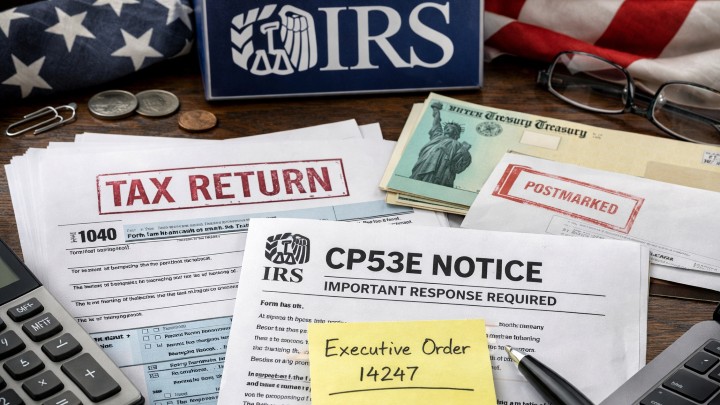
The IRS and states are issuing last-minute rules that affect this tax season - mandatory electronic payments, new CP53E refund notices, expanding state e-payment requirements, and updated USPS postmark rules. Practitioners need to stay alert.
By Gerard H. Schreiber, Jr., CPA, LCPAs
The IRS and state revenue departments have been issuing last-minute regulations and details for returns we are now in the process of preparing and filing. This adds to the uncertainty and complexity of what we are doing.
This article is meant to bring your attention to a few of the issues that may affect your efforts now. These items are:
- Executive Order 14247 - Modernizing Payments to and from America’s Bank Account
- CP53E notices
- State revenue departments electronic payment mandates
- IRS and state revenue department postmark rules
Executive Order 14247 - Modernizing Payments to and from America’s Bank Account
Like it or not, electronic payments are here. Executive Order 14247 - Modernizing Payments to and from America’s Bank Account released March 25, 2025, was issued to “promote operational efficiency by mandating the transition to electronic payments for all federal disbursements and receipts by digitizing payments to the extent permissible under applicable law (but not, for avoidance of doubt, to establish a Central Bank Digital Currency).”
There are numerous reasons mentioned in the Executive Order, including “unnecessary costs, delays and risk of fraud, lost payments, theft and inefficiencies.” We have experienced all or many of these in our practices in the last few years and they have been unnecessary distractions that affect our productivity.
Tax practitioners are left with interpreting and implementing this Executive Order during filing season for both payments and refunds.
The subject of electronic payments has been around for some time and should be familiar to most practitioners. Electronic payment mandates for various types of tax payments have been around for many years. There was never a comprehensive mandate for electronic payments until this Executive Order was issued. All practitioners are very familiar with the reasons in the Executive Order and have experienced these with taxpayer payments and refund checks.
Concerning the timing of this Executive Order, Section 3 entitled “Phase Out of Paper Check Disbursements and Receipts,” indicates Sept. 30, 2025, as the effective date of the order.
Section 3(c) states:
As soon as practicable, and to the extent permitted by law, all payments made to the Federal Government shall be processed electronically, except as specified in section 4 of this order.
The issues most mentioned by practitioners deal with taxpayers who do not have access to a computer or those who are not computer literate and unable to make electronic payments. There is a provision in the Executive Order for “Exceptions and Accommodations,” which we assume will take care of these issues.
Section 4 “Exceptions and Accommodations for the Phase Out of Paper Check Disbursements and Receipts” states:
(a) The Secretary of the Treasury shall review and, as appropriate, revise procedures for granting limited exceptions where electronic payment and collection methods are not feasible, including exceptions for:
(i) individuals who do not have access to banking services or electronic payment systems;
(ii) certain emergency payments where electronic disbursement would cause undue hardship, as contemplated in 31 C.F.R. Part 208;
(iii) national security- or law-enforcement-related activities where non-EFT transactions are necessary or desirable; and
(iv) other circumstances as determined by the Secretary of the Treasury, as reflected in regulations or other guidance.
(b) Individuals or entities qualifying for an exception under this section or other applicable law shall be provided (with) alternative payment options.
There has been no clarification from Treasury or the IRS on what is meant by these parts of the Executive Order. The most frequent comment on this is for the many who do not have banking or computer access. It should be noted about 5.6 million households do not have a checking or savings account, according to a 2023 Federal Deposit Insurance Corporation survey.
Many practitioners are assisting those without computer access in various ways to make payments with IRS Direct Pay. In some instances, practitioners are making the clients’ payments from their offices with the taxpayer present. If this is done, it is advisable to have an authorization from the taxpayer. Hopefully, the IRS and Treasury will address this situation soon.
IRS issued Fact Sheet 2026-02, Questions and answers about Executive Order 14247: Modernizing Payments To and From America’s Bank Account in January 2026 to provide general information. The Fact Sheet is divided into five topics:
- Topic A: Individual Refunds and Disbursement
- Topic B: Payments to IRS
- Topic C: Businesses
- Topic D: International Taxpayers
- Topic E: Third Party Stakeholders
Practitioners should be familiar with this Fact Sheet when preparing income tax returns in order to answer taxpayer questions and handle their needs. The Fact Sheet addresses many concerns that have been discussed since the Executive Order was issued. We are hopeful that the IRS and Treasury will continue to address practitioner and taxpayer questions on electronic payments. Practitioners should also subscribe to the various IRS email subscription services to be able to receive the latest communications from the IRS.
The IRS offers electronic options for payments, including Direct Pay and the ability for taxpayers to access their accounts online. Direct Pay allows payments for most tax returns and is user friendly. Practitioners should also be registered with E-Services to be able to use the Transcript Delivery System to access taxpayer information. Use of the Practitioner Priority Hotline is frustrating and an inefficient use of time when the information may be available online immediately.
IRS Notice CP53E
A significant procedural change for the 2026 filing season is the introduction of Notice CP53E that the IRS will issue when a tax return is filed without direct deposit information or when a financial institution rejects a direct deposit attempt. Once banking information is provided, the refund is released via direct deposit. If no response is received within 30 days and no other issues exist, the IRS will issue a paper check after six weeks. The following links are available to you on this topic: Understanding your CP53E notice and Mandates Under Executive Order 14247: Procedural Analysis of Notice CP53E and Electronic Disbursement Compliance.
State Revenue Departments Electronic Payment Mandates
Many state revenue departments and other federal and state agencies are following the IRS in mandating electronic payments. It is suggested all practitioners be familiar with the required payment methods for all returns being prepared.
USPS and State Revenue Department Postmark Rules
The U.S. Postal Service (USPS) changed the rule that formally defines what a postmark is and when it is applied. We have previously posted information on this. It could be problematic for tax filings, because if received after the due date, the document will not be considered timely filed or timely paid unless the postmark bears a date on or before the due date (IRC Section 7502).
In addition to the USPS rule, some state revenue departments have adopted similar rules on postmarks for returns and payments. You should be aware of the particular rules for each state return you are preparing.
Summary
We live in a world where instantaneous change is possible and we have to adapt to it. In these final days before the April 15 deadline, these items require us to be vigilant and constantly monitoring everything associated with the returns we are preparing and processing.
Good luck!
Topics: