Navigating Timekeeping Compliance in Government Contracting

By Jim Wesloh

In the heart of Texas, where the business landscape is as vast and dynamic as the state itself, the role of CPAs and finance professionals extends beyond the traditional confines of accounting. With the U.S. government channeling over $700 billion annually into contracts, a significant slice of this national pie finds its way to the Lone Star State.

This influx underscores the critical importance for Texas contractors to maintain an impeccable accounting system, with a spotlight on rigorous timekeeping and labor distribution practices. The stakes are high, as any deviation from compliance could lead to the withholding of government payments, a scenario no business wants to encounter.

At the core of this compliance challenge lies the need to navigate a labyrinth of government requirements and regulations. It's not merely about ticking boxes to fulfill contractual obligations but safeguarding the integrity and credibility of government contracting.

For Texas CPAs and finance professionals, this means adopting an unwavering commitment to meticulous timekeeping. Governed by a complex web of regulations, understanding and adhering to these standards is paramount for ensuring contractors' compliance with federal mandates and upholding the transparency and accountability of projects funded by taxpayer dollars.

The multifaceted requirements of timekeeping for government contractors is detailed in key documents, such as the Federal Acquisition Regulations (FAR), the Defense Federal Acquisition Regulation Supplement (DFARS), and the Defense Contract Audit Agency’s (DCAA) Contract Audit Manual (CAM), among others.

Within these requirements lies the necessity for precise and daily recording of labor hours. This foundational aspect, outlined by the CAM and DCAA's Information for Contractors (Info), ensures that each hour worked is accurately captured and attributed to the correct cost objectives. The emphasis on daily recording of accurate data underpins the system's integrity, minimizing the potential for errors or misrepresentations.

Equally critical is the implementation of robust work authorizations. These authorizations, including specific identifiers and detailed descriptions, must be clearly communicated to employees. This practice not only aligns with DCAA guidelines but also establishes a clear linkage between the employee's work and specific contract objectives, enhancing the traceability and accountability of labor charges.

The system's integrity is further reinforced through strict authentication measures for timesheet access. As per CAM guidelines, each timesheet must be uniquely linked to an individual employee, prohibiting shared access and ensuring that the recorded time is reliably attributable to the correct person.

Changes to time entries are inevitable, yet they must be managed with a rigorous audit trail. This audit trail, as described by the CAM and DCAA Info, must capture all initial entries, subsequent changes and include detailed justifications for each alteration. This level of scrutiny ensures that any modifications to time records are transparent, verifiable and justifiable.

Employee certification and supervisor approval processes are pivotal in this ecosystem. Employees are required to certify that their timesheets accurately reflect the hours worked, aligning with the CAM and DCAA Info directives. Similarly, supervisor oversight is a critical check in the process, ensuring that the timesheets are thoroughly reviewed and cosigned, adding an additional layer of verification.

In scenarios where employees are absent or on travel, the guidelines provide clear directives for timesheet preparation and subsequent verification upon the employee's return. This aspect underscores the system's flexibility, while maintaining its rigor.

The integration of timekeeping data with the General Ledger, as stipulated by DFARS and the Standard Form 1408 Preaward Survey, ensures a seamless flow of information from time recording to financial reporting. This integration is vital for maintaining accurate and current project cost records, facilitating timely and accurate billing and financial management.

The system must also be equipped to withstand DCAA floor checks, demonstrating that time is charged appropriately, and adjusted entries are well-documented and approved, as outlined in DFARS. This readiness for audit and inspection is a testament to the system's robustness and compliance orientation.

Finally, record retention policies, as detailed in FAR, dictate the preservation of payroll-related records both during and after the completion of work. This practice not only serves as a historical record, but also as a crucial resource for audits and reviews.

Here are the specific practices that underpin timekeeping compliance and accountability in government contracting:

  • Timekeeping mandate
  • Work authorizations
  • Authentication and timesheet integrity
  • Daily recording of labor
  • Audit trails for time entries
  • Employee certification and supervisor approval
  • Supervisor completion of timesheets
  • General Ledger integration
  • DCAA floor checks
  • Record retention policies
  • Direct and indirect cost segregation
  • Cost accounting and unallowable costs

If you would like more details on each of these practices, download the white paper “Mastering the Art of Timekeeping: Navigating Compliance in Government Contracting” available on the PROCAS website.

In Texas, where the spirit of independence and excellence runs deep, CPAs and financial professionals play a pivotal role in steering government contractors toward unwavering compliance and operational success. Mastering the art of timekeeping in government contracting is not just about meeting federal standards; it's a testament to the commitment of Texas' finance professionals to uphold the highest standards of integrity and accountability.

About the Author: Jim Wesloh is the founder of PROCAS, a leading provider of financial solutions for government contractors. Wesloh is a University of Cincinnati alumnus.

About PROCAS: PROCAS has been a market leader in project accounting for government contractors for over 25 years. With its unparalleled expertise and innovative, customer-focused solutions, PROCAS remains committed to helping contractors seamlessly navigate the complexities of government contracting. To learn more about PROCAS, visit the Web and LinkedIn.

TXCPA’s Single Audits and Governmental Accounting and Auditing Conference

Make plans to attend TXCPA's Single Audits and Governmental Accounting and Auditing Conference in Austin this September! Tailored for professionals working with or for government entities, this program provides essential regulatory updates.

The conference will include expert-led sessions on emerging topics such as compliance, cybersecurity, and more. Don’t miss this chance to expand your expertise and connect with peers. Stay tuned to the TXCPA website for upcoming details on session topics.

Thanks to the Sponsors of Today's CPA Magazine

This content was made possible by the sponsors of this issue of Today's CPA Magazine:
Accounting Biz Brokers

Accounting Practice Sales

Capstan

CPA Charge

Goodman Financial

Poe Group Advisors


  • Large Language Models

    AI in Accounting 2026: From Practical Automation to Strategic Advantage

    AI in 2026 is integrated into accounting workflows, moving from simple assistance to agentic systems that automate document intake, data extraction, exception management and review-ready outputs. CPAs spend less time on manual tasks and more on judgment, oversight and communication. Organizations that adopt AI deliberately gain efficiency and quality while those with weak processes see their gaps exposed.
    View Article
  • CPE: AI-Powered Tax Compliance, Part 2

    Machine learning is becoming central to sales and use tax operations, improving taxability classification, reducing manual review and strengthening auditability through NLP, dual‑threshold controls and human‑in‑the‑loop review. Case studies show ML reducing false negatives, cutting coding hours and accelerating reconciliation with anomaly detection. With strong governance and expert oversight, ML enhances accuracy, efficiency and compliance while allowing tax professionals to focus on higher‑value advisory work.
    View Article
    LLMs
  • LLMs

    Beyond Compliance – The Ways CPAs and CMAs Can Embrace the AI-Powered Future

    AI is shifting accounting from routine compliance work to higher-value analysis and advisory roles. CPAs and CMAs can use GenAI to automate repetitive tasks, improve risk analysis and forecasting, and streamline onboarding and documentation with custom GPTs and low-code tools. To adopt AI responsibly, professionals must understand its limits, verify outputs and start small - improving one workflow at a time while maintaining strong judgment and ethical oversight.
    View Article
  • Leading Together in an Evolving Profession

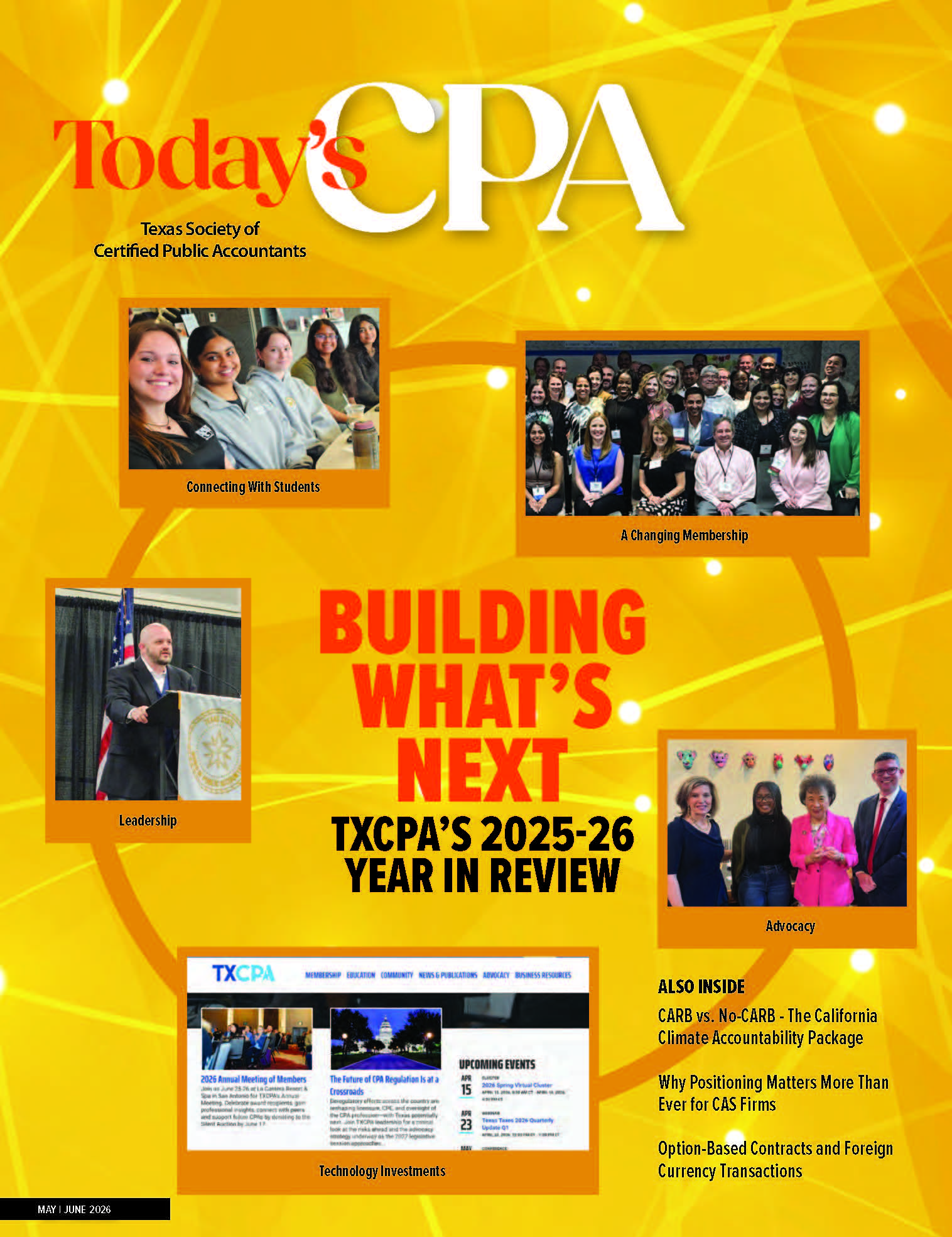
    Rapid technological change, especially AI, is reshaping how CPAs serve clients and employers, and this issue of Today’s CPA focuses on helping members lead through that evolution. It features articles on AI in accounting, corporate governance and AI-powered tax compliance, along with statewide chapter updates and a preview of Accounting Opportunities Month. The message emphasizes engagement, lifelong learning and the shared responsibility to strengthen the profession and inspire future CPAs.
    View Article
    TXCPA Accounting Opportunities Month
  • Universal Proxy Card Rules

    Activism Amplified: How Universal Proxy Rules Are Reshaping Corporate Governance

    Universal proxy rules have shifted power dynamics in contested board elections, lowering barriers for activists and increasing pressure on boards to perform, communicate clearly and govern transparently. Companies that fail to proactively engage shareholders, maintain strong internal controls and align strategy with investor expectations face greater risk of disruptive and costly proxy contests - even if activists do not ultimately win board seats.
    View Article
  • Bridging the Skills Gap in ESG - How CPAs Can Prepare for a Growing Service Area

    As ESG reporting becomes mainstream, CPAs are increasingly expected to measure, report and assure nonfinancial data. This article outlines the key competencies needed for ESG roles. By building these capabilities now, CPAs can prepare for one of the fastest-growing areas of the profession.
    View Article
    Sustainability reporting
  • Texas Legislature

    Advocacy Never Stops

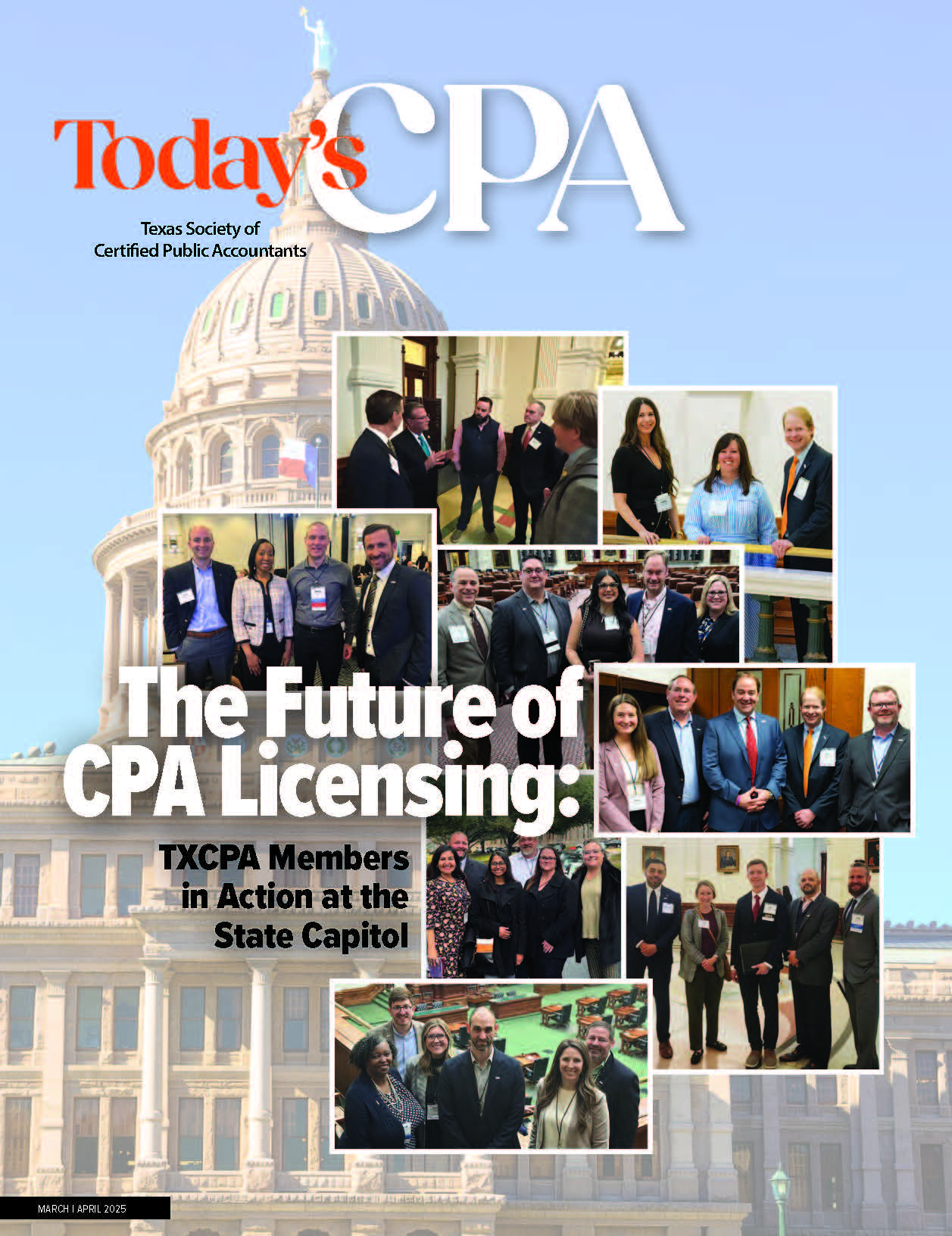
    TXCPA is continuing its advocacy momentum after the successful passage of SB 262 and SB 522 in 2025, which created a new CPA licensure pathway and modernized mobility. As rules for the bachelor’s pathway are finalized, TXCPA is actively engaged with TSBPA. The 2026 election is expected to bring major turnover Texas Legislature. The Society is preparing to educate new lawmakers and defend against deregulatory efforts that could weaken licensing standards.
    View Article
  • Momentum and Vision: Key Takeaways from the 2026 Midyear Leadership Council and Members Meeting

    TXCPA’s 2026 Midyear Leadership Council and Members Meeting brought members together in College Station for financial and governance updates, a discussion of proposed Bylaws changes, news on AcctoFi’s launch, and more. The meeting also showcased major advocacy achievements, technology upgrades, continued progress in strengthening the talent pipeline, and long‑term trends shaping the profession. The event closed with a dynamic advocacy panel and an invitation for members to stay involved ahead of the June 2026 Annual Meeting.
    View Article
    TXCPA Bylaws
  • TXCPA Accounting Opportunities Month

    Inspiring the Next Generation - Accounting Opportunities Months

    TXCPA’s Accounting Opportunities Months connect CPA volunteers with Texas students through career talks, financial literacy presentations and community outreach. Volunteers showcase accounting as a dynamic, impactful profession while helping students build essential money management skills and explore diverse career paths. TXCPA is aiming to expand the impact to students statewide, strengthening the future of the CPA profession through education, mentorship and community connection.
    View Article
  • Understanding the Stakeholder Model of Corporate Social Responsibility

    Corporate Social Responsibility continues to evolve amid political, regulatory and resource pressures, yet most business leaders still view it as essential to long-term success. Although balancing diverse stakeholder needs can be challenging, opportunities exist to measure impact, improve engagement and integrate ethical practices into decision-making. Understanding and prioritizing stakeholder expectations remain critical drivers of sustainable organizational growth.
    View Article
    State of Corporate Purpose Report
  • What’s Happening Around Texas

    Chapters across Texas have been actively engaging their communities through service, celebration and connection. Highlights include Austin’s support at the TSBPA Swearing-In Ceremony, Corpus Christi’s successful toy drive, Dallas’ holiday gatherings and service projects, Fort Worth’s large Santaccountant toy collection and scholarship fundraiser, and Houston’s lively Mix and Mingle social. Together, these activities highlight the statewide spirit of service, networking and support within TXCPA.
    View Article
  • Take Note

    In this edition of Take Note: TXCPA’s All New Mentor Match Program; Unlock New Opportunities with the CGMA® Designation; ACAN Delivers Confidential Support When You Need It Most; 2025-2026 AcctoFi Scholarship Recipients
    View Article
    Peer Assisatance
  • Classifieds

    The Classifieds section provides a centralized place to find practices for sale, buyers seeking to acquire firms and specialized services, helping members efficiently connect with opportunities to expand, sell or pursue niche markets.
    View Article

CHAIR
Mohan Kuruvilla, Ph.D., CPA

PRESIDENT/CEO
Jodi Ann Ray, CAE, CCE, IOM

CHIEF OPERATING OFFICER
Melinda Bentley, CAE

EDITORIAL BOARD CHAIR
Jennifer Johnson, CPA

MANAGER, MARKETING AND COMMUNICATIONS
Peggy Foley
pfoley@tx.cpa

MANAGING EDITOR
DeLynn Deakins
ddeakins@tx.cpa

COLUMN EDITOR
Don Carpenter, MSAcc/CPA

DIGITAL MARKETING SPECIALIST
Wayne Hardin, CDMP, PCM®

CLASSIFIEDS
DeLynn Deakins

Texas Society of CPAs
14131 Midway Rd., Suite 850
Addison, TX 75001
972-687-8550
ddeakins@tx.cpa


Editorial Board
Derrick Bonyuet-Lee, CPA-Austin;
Aaron Borden, CPA-Dallas;
Don Carpenter, CPA-Central Texas;
Rhonda Fronk, CPA-Houston;
Aaron Harris, CPA-Dallas;
Baria Jaroudi, CPA-Houston;
Elle Kathryn Johnson, CPA-Houston;
Jennifer Johnson, CPA-Dallas;
Lucas LaChance, CPA-Dallas, CIA;
Nicholas Larson, CPA-Fort Worth;
Anne-Marie Lelkes, CPA-Corpus Christi;
Bryan Morgan, Jr, CPA-Austin;
Stephanie Morgan, CPA-East Texas;
Kamala Raghavan, CPA-Houston;
Amber Louise Rourke, CPA-Brazos Valley;
Shilpa Boggram Sathyamurthy, CPA-Houston, CA
Nikki Lee Shoemaker, CPA-East Texas, CGMA;
Natasha Winn, CPA-Houston.

CONTRIBUTORS
Melinda Bentley; Kenneth Besserman; Kristie Estrada; Holly McCauley; Craig Nauta; Kari Owen; John Ross; Lani Shepherd; April Twaddle; Patty Wyatt