June 11, 2025

Accounting Firms Continue to Innovate in Response to Rapidly Changing Market Conditions

By Don Carpenter, MSAcc/CPA

An announcement in March 2024 that Grant Thornton had agreed to sell a majority interest in the firm to a private equity group, New Mountain Capital LLC, may be a tipping point in the evolution of the profession. Only time will tell, but it is certainly not the first firm to look outside itself or its competitors for capital and innovation.

As this column has highlighted, the profession has faced a new environment in the post-pandemic world. The number of entrants into the profession has been steadily declining. The AICPA 2021 Trends Report reported that the number of individuals taking the CPA Exam in 2021 was less than 70% of those taking it in 2016. And all indications are that the number has continued to decline further.

Firms have considered innovative approaches to recruiting and retaining talent (“Will Others Follow BDO’s Lead to Attract and Retain Staff?” July/August 2024 Today’s CPA issue). A shortage of qualified professionals is a reality even as financial reporting and controls become ever more complex.

Those in specialized areas such as consulting and advisory services have seen prospects dim as higher interest rates have slowed M&A activity. In the area of tax, the IRS continues to expand the rollout of its e-file system to larger numbers of filers creating uncertainty for tax practitioners. But one of the most common reasons cited by students opting out of accounting is concern for their long-term prospects fueled in part by the role artificial intelligence may play.

With firms struggling to attract talented, qualified individuals, the problem quickly becomes the proverbial “chicken and the egg” as they are forced to consider the efficiencies artificial intelligence offers, further raising the angst of those considering accounting careers. Just like investment in staff, however, investment in technology requires capital and often in large amounts (see “Artificial Intelligence Offers Turbo Charged Solutions While Raising Concerns Regarding Security and Professional Integrity” January/February 2024 Today’s CPA issue).

As the earlier article indicated, the Big Four have committed large capital allocations to investments in AI. Regional and smaller firms may be forced to look outside for resources required to remain competitive in a technology driven environment.

It is within this context that Grant Thornton, the seventh-largest CPA firm, announced that it was selling a stake to New Mountain Capital for $2.4 billion. The investment will be in the U.S. arm of Grant Thornton, which accounts for over 10% of worldwide personnel.

In preparation for the transaction, the firm has announced staff reductions of about 350 individuals, which follows reductions made in 2023. In addition, the firm will operate in a split structure, with Grant Thornton LLP offering assurance services and Grant Thornton Advisors LLC providing non-attest services. The investment will give New Mountain control of Grant Thornton pending regulatory approval.

In joint press releases, the principles explain that the investment will be used in part to reduce equity of existing partners and buy out obligations to retired partners. But the primary motivation for the transaction is to provide funding for capital investments in technology, as well as increased acquisition activity.

This is not the first marriage between a CPA firm and private equity, only the largest. In fact, New Mountain Capital acquired a controlling interest in Citrin Cooperman in 2022. With over $700 mm in annual revenues, it too ranked in the top 25 U.S. accounting firms. There appear to be no plans to merge the two firms at this time.

New Mountain Capital is not the only private equity firm to see opportunity in the sector. The first such transaction between a top 25 CPA firm and private equity was in 2021 when TowerBrook Capital Partners invested in EisnerAmper, LLP. In 2022, Cherry Bekaert rebranded itself in conjunction with an equity investment by Parthenon Capital. And earlier in 2024, Hellman & Friedman and Valeas Capital Partners announced a $1 billion investment in Baker Tilley US, LLP.

Has this strategy proved effective? For those earlier transactions, revenue growth has outpaced the pier group; however, much of the growth has been acquisition fueled.

As the partnership activity between CPA firms and private equity gains steam, there are important implications for the profession. Although obviously profit motivated, CPA firms have fiduciary and professional obligations that may conflict with the models that private equity is accustomed to working within. Objectivity and independence may be under pressure as investors consider their returns. And what is the exit strategy for investors who typically invest for four-to-seven-year horizons

Firms are faced with the responsibility of investing this newfound capital wisely and the oversight of the private equity firms might be just the control that ensures this occurs. If the smaller firms are able to leverage these transactions to make the technological advancements that the profession is demanding, it could be the key to helping them keep pace with the Big Four by offering more options for clients and a more competitive environment, which typically drives further innovation. As was stated earlier, “Only time will tell!”

About the Author: Don Carpenter, MSAcc/CPA, is clinical professor of accounting at Baylor University. Contact him at Don_Carpenter@baylor.edu.

Thanks to the Sponsors of Today's CPA Magazine

This content was made possible by the sponsors of this issue of Today's CPA Magazine:
Accounting Biz Brokers

Accounting Practice Sales

CPA Charge

Goodman Financial

Poe Group Advisors

SafeSend


  • Large Language Models

    AI in Accounting 2026: From Practical Automation to Strategic Advantage

    AI in 2026 is integrated into accounting workflows, moving from simple assistance to agentic systems that automate document intake, data extraction, exception management and review-ready outputs. CPAs spend less time on manual tasks and more on judgment, oversight and communication. Organizations that adopt AI deliberately gain efficiency and quality while those with weak processes see their gaps exposed.
    View Article
  • CPE: AI-Powered Tax Compliance, Part 2

    Machine learning is becoming central to sales and use tax operations, improving taxability classification, reducing manual review and strengthening auditability through NLP, dual‑threshold controls and human‑in‑the‑loop review. Case studies show ML reducing false negatives, cutting coding hours and accelerating reconciliation with anomaly detection. With strong governance and expert oversight, ML enhances accuracy, efficiency and compliance while allowing tax professionals to focus on higher‑value advisory work.
    View Article
    LLMs
  • LLMs

    Beyond Compliance – The Ways CPAs and CMAs Can Embrace the AI-Powered Future

    AI is shifting accounting from routine compliance work to higher-value analysis and advisory roles. CPAs and CMAs can use GenAI to automate repetitive tasks, improve risk analysis and forecasting, and streamline onboarding and documentation with custom GPTs and low-code tools. To adopt AI responsibly, professionals must understand its limits, verify outputs and start small - improving one workflow at a time while maintaining strong judgment and ethical oversight.
    View Article
  • Leading Together in an Evolving Profession

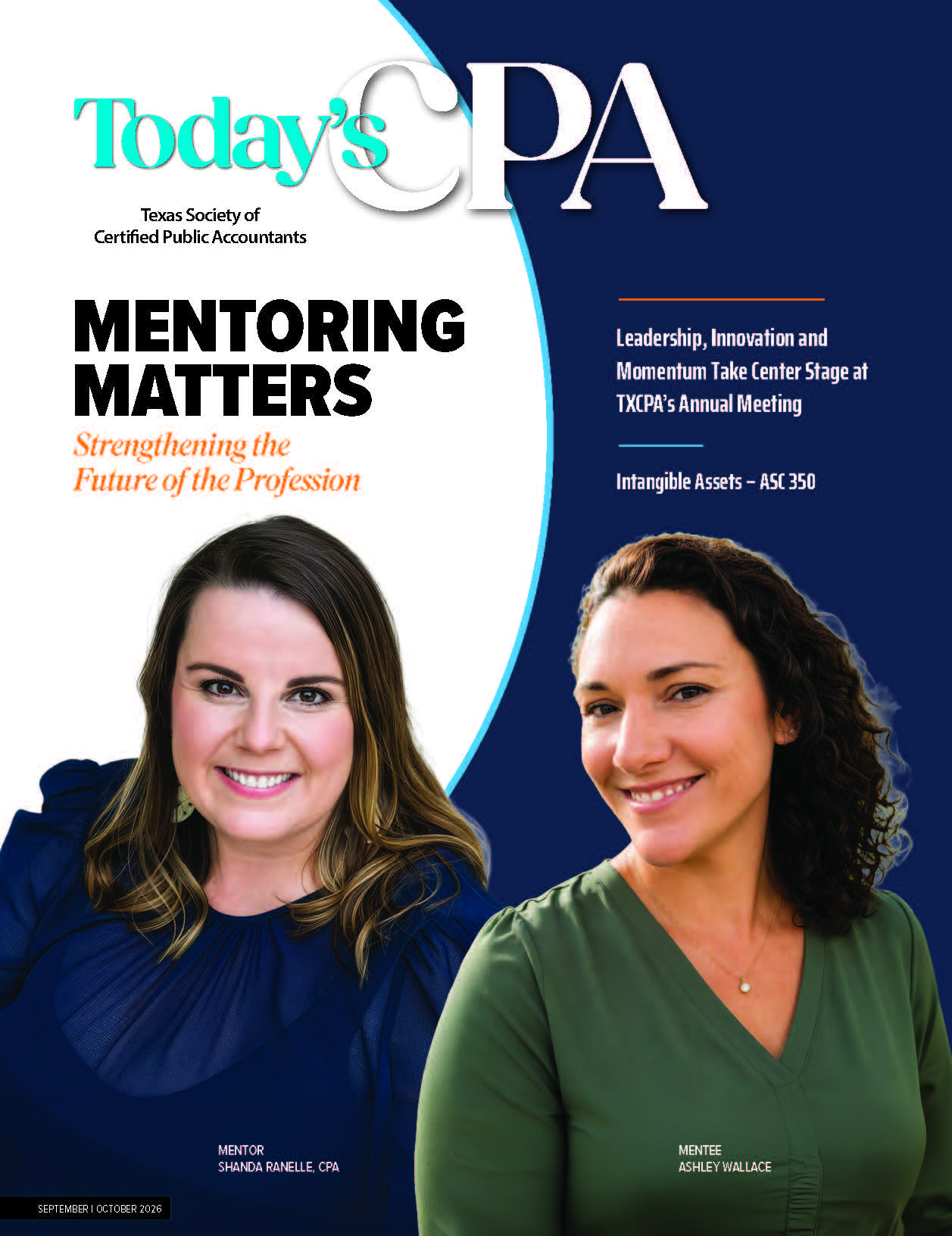
    Rapid technological change, especially AI, is reshaping how CPAs serve clients and employers, and this issue of Today’s CPA focuses on helping members lead through that evolution. It features articles on AI in accounting, corporate governance and AI-powered tax compliance, along with statewide chapter updates and a preview of Accounting Opportunities Month. The message emphasizes engagement, lifelong learning and the shared responsibility to strengthen the profession and inspire future CPAs.
    View Article
    TXCPA Accounting Opportunities Month
  • Universal Proxy Card Rules

    Activism Amplified: How Universal Proxy Rules Are Reshaping Corporate Governance

    Universal proxy rules have shifted power dynamics in contested board elections, lowering barriers for activists and increasing pressure on boards to perform, communicate clearly and govern transparently. Companies that fail to proactively engage shareholders, maintain strong internal controls and align strategy with investor expectations face greater risk of disruptive and costly proxy contests - even if activists do not ultimately win board seats.
    View Article
  • Bridging the Skills Gap in ESG - How CPAs Can Prepare for a Growing Service Area

    As ESG reporting becomes mainstream, CPAs are increasingly expected to measure, report and assure nonfinancial data. This article outlines the key competencies needed for ESG roles. By building these capabilities now, CPAs can prepare for one of the fastest-growing areas of the profession.
    View Article
    Sustainability reporting
  • Texas Legislature

    Advocacy Never Stops

    TXCPA is continuing its advocacy momentum after the successful passage of SB 262 and SB 522 in 2025, which created a new CPA licensure pathway and modernized mobility. As rules for the bachelor’s pathway are finalized, TXCPA is actively engaged with TSBPA. The 2026 election is expected to bring major turnover Texas Legislature. The Society is preparing to educate new lawmakers and defend against deregulatory efforts that could weaken licensing standards.
    View Article
  • Momentum and Vision: Key Takeaways from the 2026 Midyear Leadership Council and Members Meeting

    TXCPA’s 2026 Midyear Leadership Council and Members Meeting brought members together in College Station for financial and governance updates, a discussion of proposed Bylaws changes, news on AcctoFi’s launch, and more. The meeting also showcased major advocacy achievements, technology upgrades, continued progress in strengthening the talent pipeline, and long‑term trends shaping the profession. The event closed with a dynamic advocacy panel and an invitation for members to stay involved ahead of the June 2026 Annual Meeting.
    View Article
    TXCPA Bylaws
  • TXCPA Accounting Opportunities Month

    Inspiring the Next Generation - Accounting Opportunities Months

    TXCPA’s Accounting Opportunities Months connect CPA volunteers with Texas students through career talks, financial literacy presentations and community outreach. Volunteers showcase accounting as a dynamic, impactful profession while helping students build essential money management skills and explore diverse career paths. TXCPA is aiming to expand the impact to students statewide, strengthening the future of the CPA profession through education, mentorship and community connection.
    View Article
  • Understanding the Stakeholder Model of Corporate Social Responsibility

    Corporate Social Responsibility continues to evolve amid political, regulatory and resource pressures, yet most business leaders still view it as essential to long-term success. Although balancing diverse stakeholder needs can be challenging, opportunities exist to measure impact, improve engagement and integrate ethical practices into decision-making. Understanding and prioritizing stakeholder expectations remain critical drivers of sustainable organizational growth.
    View Article
    State of Corporate Purpose Report
  • What’s Happening Around Texas

    Chapters across Texas have been actively engaging their communities through service, celebration and connection. Highlights include Austin’s support at the TSBPA Swearing-In Ceremony, Corpus Christi’s successful toy drive, Dallas’ holiday gatherings and service projects, Fort Worth’s large Santaccountant toy collection and scholarship fundraiser, and Houston’s lively Mix and Mingle social. Together, these activities highlight the statewide spirit of service, networking and support within TXCPA.
    View Article
  • Take Note

    In this edition of Take Note: TXCPA’s All New Mentor Match Program; Unlock New Opportunities with the CGMA® Designation; ACAN Delivers Confidential Support When You Need It Most; 2025-2026 AcctoFi Scholarship Recipients
    View Article
    Peer Assisatance
  • Classifieds

    The Classifieds section provides a centralized place to find practices for sale, buyers seeking to acquire firms and specialized services, helping members efficiently connect with opportunities to expand, sell or pursue niche markets.
    View Article

CHAIR
Mohan Kuruvilla, Ph.D., CPA

PRESIDENT/CEO
Jodi Ann Ray, CAE, CCE, IOM

CHIEF OPERATING OFFICER
Melinda Bentley, CAE

EDITORIAL BOARD CHAIR
Jennifer Johnson, CPA

MANAGER, MARKETING AND COMMUNICATIONS
Peggy Foley
pfoley@tx.cpa

MANAGING EDITOR
DeLynn Deakins
ddeakins@tx.cpa

COLUMN EDITOR
Don Carpenter, MSAcc/CPA

DIGITAL MARKETING SPECIALIST
Wayne Hardin, CDMP, PCM®

CLASSIFIEDS
DeLynn Deakins

Texas Society of CPAs
14131 Midway Rd., Suite 850
Addison, TX 75001
972-687-8550
ddeakins@tx.cpa


Editorial Board
Derrick Bonyuet-Lee, CPA-Austin;
Aaron Borden, CPA-Dallas;
Don Carpenter, CPA-Central Texas;
Rhonda Fronk, CPA-Houston;
Aaron Harris, CPA-Dallas;
Baria Jaroudi, CPA-Houston;
Elle Kathryn Johnson, CPA-Houston;
Jennifer Johnson, CPA-Dallas;
Lucas LaChance, CPA-Dallas, CIA;
Nicholas Larson, CPA-Fort Worth;
Anne-Marie Lelkes, CPA-Corpus Christi;
Bryan Morgan, Jr, CPA-Austin;
Stephanie Morgan, CPA-East Texas;
Kamala Raghavan, CPA-Houston;
Amber Louise Rourke, CPA-Brazos Valley;
Shilpa Boggram Sathyamurthy, CPA-Houston, CA
Nikki Lee Shoemaker, CPA-East Texas, CGMA;
Natasha Winn, CPA-Houston.

CONTRIBUTORS
Melinda Bentley; Kenneth Besserman; Kristie Estrada; Holly McCauley; Craig Nauta; Kari Owen; John Ross; Lani Shepherd; April Twaddle; Patty Wyatt