July 01, 2024

Will Others Follow BDO’s Lead to Attract and Retain Staff?

By Don Carpenter, MSAcc/CPA

The shrinking number of new entrants into the accounting profession and the number of those leaving the profession in the post-pandemic years has been widely reported by the business press. In addition to the perception that the degree and certification make for difficult qualification, the starting compensation for entry level accountants has failed to keep up with competing majors such as finance.

In this environment, BDO USA announced last year that it had implemented an Employee Stock Ownership Plan (ESOP) to distribute the ownership of the firm across its employee base. This is a distinct break from the traditional partnership models that have governed the accounting profession for years.

Prior to BDO’s departure from the standard, accountants faced a demanding career path, aiming for a partner position that only one in 50 achieve, causing many to leave public accounting early. The partnership structure also presents tax complications, as partners are taxed at higher personal rates compared to the 20% corporate rate and state tax returns must be filed for each partner’s profit allocation in every state the firm operates. This model can lead partners to prioritize short-term profits over long-term growth.

BDO has shifted away from this model, placing ownership in the hands of its 10,000 employees. This is not entirely unprecedented. Redpath and Company used a Subchapter S structure for a similar change 20 years ago, followed by other small firms. However, BDO’s decision is notable as it is the 6th largest accounting firm in the United States.

To implement the ESOP, BDO converted from a limited liability partnership to a professional corporation (PC), a structure reserved for licensed professionals like accountants, attorneys and engineers. In a PC, ownership is in shares and individuals are liable for their own negligence but not of other owners.

BDO’s ownership shifted to shareholders and a $1.3 billion debt was arranged to create an ESOP trust managed by a third-party trustee. This debt funded the purchase of shares from former partners, which were then allocated to employees based on their salaries. BDO can deduct these contributions and the interest on the debt for tax purposes.

Details of BDO’s ESOP are not fully disclosed, but typically participants vest in shares similarly to a 401(k) plan. Vesting can occur either on a three-year cliff basis or a five-year graded schedule. Payouts, generally in cash, are triggered by retirement, death or disability, based on the shares’ fair market value.

Shares repurchased from employees’ accounts can be reused for future awards, with payouts as lump sums or equal payments over up to five years. Extended payout periods apply to balances above IRS-set amounts.

Since “partners” will remain the more highly compensated employees in the new BDO model, they’ll receive the largest ESOP allocations, but now non-partner employees also have a stake in the business’s success. If BDO prospers, ESOP participants’ accounts increase in value, aligning interests across all staff levels.

The ESOP motivates employees to stay with BDO, rewarding longevity with annual share allocations and allowing employees to benefit from the firm’s long-term success. Only time will tell if other large and mid-market firms consider the ESOP structure, but at a minimum, one can assume they will be monitoring the impact it has on BDO’s success.

About the Author: Don Carpenter, MSAcc/CPA, is clinical professor of accounting at Baylor University. Contact him at Don_Carpenter@baylor.edu.


Thanks to the Sponsors of Today's CPA Magazine

This content was made possible by the sponsors of this issue of Today's CPA Magazine:
 
Accounting Biz Brokers Accounting Practice Sales CPA Charge Goodman Financial PAS.Professional Accounting Sales Poe Group Advisors


  • Large Language Models

    AI in Accounting 2026: From Practical Automation to Strategic Advantage

    AI in 2026 is integrated into accounting workflows, moving from simple assistance to agentic systems that automate document intake, data extraction, exception management and review-ready outputs. CPAs spend less time on manual tasks and more on judgment, oversight and communication. Organizations that adopt AI deliberately gain efficiency and quality while those with weak processes see their gaps exposed.
    View Article
  • CPE: AI-Powered Tax Compliance, Part 2

    Machine learning is becoming central to sales and use tax operations, improving taxability classification, reducing manual review and strengthening auditability through NLP, dual‑threshold controls and human‑in‑the‑loop review. Case studies show ML reducing false negatives, cutting coding hours and accelerating reconciliation with anomaly detection. With strong governance and expert oversight, ML enhances accuracy, efficiency and compliance while allowing tax professionals to focus on higher‑value advisory work.
    View Article
    LLMs
  • LLMs

    Beyond Compliance – The Ways CPAs and CMAs Can Embrace the AI-Powered Future

    AI is shifting accounting from routine compliance work to higher-value analysis and advisory roles. CPAs and CMAs can use GenAI to automate repetitive tasks, improve risk analysis and forecasting, and streamline onboarding and documentation with custom GPTs and low-code tools. To adopt AI responsibly, professionals must understand its limits, verify outputs and start small - improving one workflow at a time while maintaining strong judgment and ethical oversight.
    View Article
  • Leading Together in an Evolving Profession

    Rapid technological change, especially AI, is reshaping how CPAs serve clients and employers, and this issue of Today’s CPA focuses on helping members lead through that evolution. It features articles on AI in accounting, corporate governance and AI-powered tax compliance, along with statewide chapter updates and a preview of Accounting Opportunities Month. The message emphasizes engagement, lifelong learning and the shared responsibility to strengthen the profession and inspire future CPAs.
    View Article
    TXCPA Accounting Opportunities Month
  • Universal Proxy Card Rules

    Activism Amplified: How Universal Proxy Rules Are Reshaping Corporate Governance

    Universal proxy rules have shifted power dynamics in contested board elections, lowering barriers for activists and increasing pressure on boards to perform, communicate clearly and govern transparently. Companies that fail to proactively engage shareholders, maintain strong internal controls and align strategy with investor expectations face greater risk of disruptive and costly proxy contests - even if activists do not ultimately win board seats.
    View Article
  • Bridging the Skills Gap in ESG - How CPAs Can Prepare for a Growing Service Area

    As ESG reporting becomes mainstream, CPAs are increasingly expected to measure, report and assure nonfinancial data. This article outlines the key competencies needed for ESG roles. By building these capabilities now, CPAs can prepare for one of the fastest-growing areas of the profession.
    View Article
    Sustainability reporting
  • Texas Legislature

    Advocacy Never Stops

    TXCPA is continuing its advocacy momentum after the successful passage of SB 262 and SB 522 in 2025, which created a new CPA licensure pathway and modernized mobility. As rules for the bachelor’s pathway are finalized, TXCPA is actively engaged with TSBPA. The 2026 election is expected to bring major turnover Texas Legislature. The Society is preparing to educate new lawmakers and defend against deregulatory efforts that could weaken licensing standards.
    View Article
  • Momentum and Vision: Key Takeaways from the 2026 Midyear Leadership Council and Members Meeting

    TXCPA’s 2026 Midyear Leadership Council and Members Meeting brought members together in College Station for financial and governance updates, a discussion of proposed Bylaws changes, news on AcctoFi’s launch, and more. The meeting also showcased major advocacy achievements, technology upgrades, continued progress in strengthening the talent pipeline, and long‑term trends shaping the profession. The event closed with a dynamic advocacy panel and an invitation for members to stay involved ahead of the June 2026 Annual Meeting.
    View Article
    TXCPA Bylaws
  • TXCPA Accounting Opportunities Month

    Inspiring the Next Generation - Accounting Opportunities Months

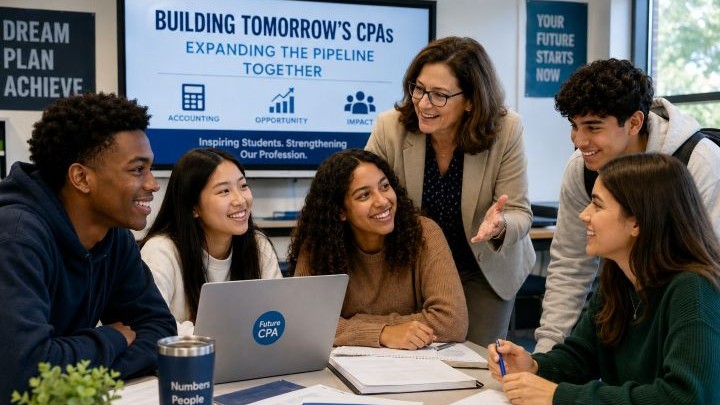
    TXCPA’s Accounting Opportunities Months connect CPA volunteers with Texas students through career talks, financial literacy presentations and community outreach. Volunteers showcase accounting as a dynamic, impactful profession while helping students build essential money management skills and explore diverse career paths. TXCPA is aiming to expand the impact to students statewide, strengthening the future of the CPA profession through education, mentorship and community connection.
    View Article
  • Understanding the Stakeholder Model of Corporate Social Responsibility

    Corporate Social Responsibility continues to evolve amid political, regulatory and resource pressures, yet most business leaders still view it as essential to long-term success. Although balancing diverse stakeholder needs can be challenging, opportunities exist to measure impact, improve engagement and integrate ethical practices into decision-making. Understanding and prioritizing stakeholder expectations remain critical drivers of sustainable organizational growth.
    View Article
    State of Corporate Purpose Report
  • What’s Happening Around Texas

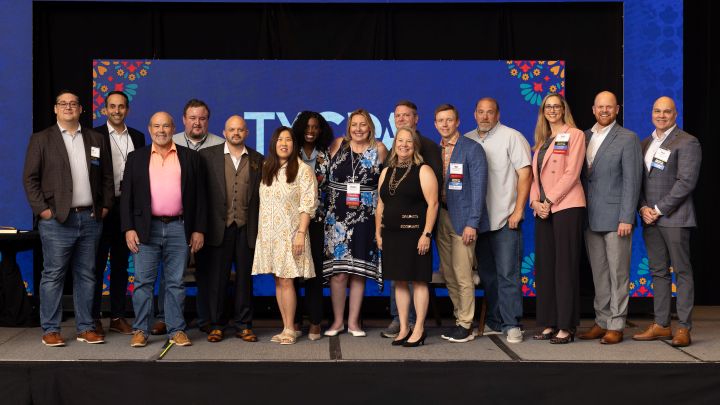
    Chapters across Texas have been actively engaging their communities through service, celebration and connection. Highlights include Austin’s support at the TSBPA Swearing-In Ceremony, Corpus Christi’s successful toy drive, Dallas’ holiday gatherings and service projects, Fort Worth’s large Santaccountant toy collection and scholarship fundraiser, and Houston’s lively Mix and Mingle social. Together, these activities highlight the statewide spirit of service, networking and support within TXCPA.
    View Article
  • Take Note

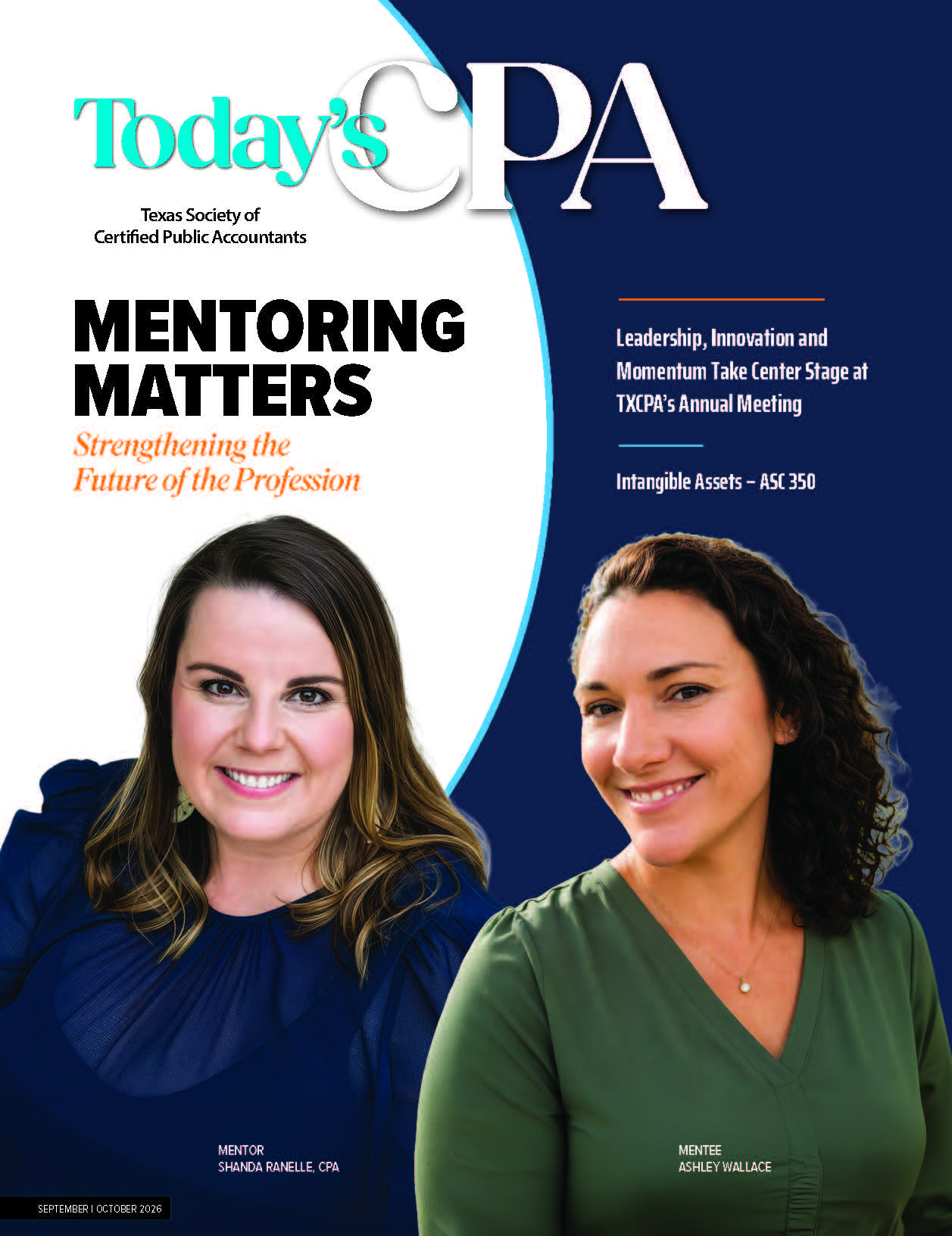
    In this edition of Take Note: TXCPA’s All New Mentor Match Program; Unlock New Opportunities with the CGMA® Designation; ACAN Delivers Confidential Support When You Need It Most; 2025-2026 AcctoFi Scholarship Recipients
    View Article
    Peer Assisatance
  • Classifieds

    The Classifieds section provides a centralized place to find practices for sale, buyers seeking to acquire firms and specialized services, helping members efficiently connect with opportunities to expand, sell or pursue niche markets.
    View Article

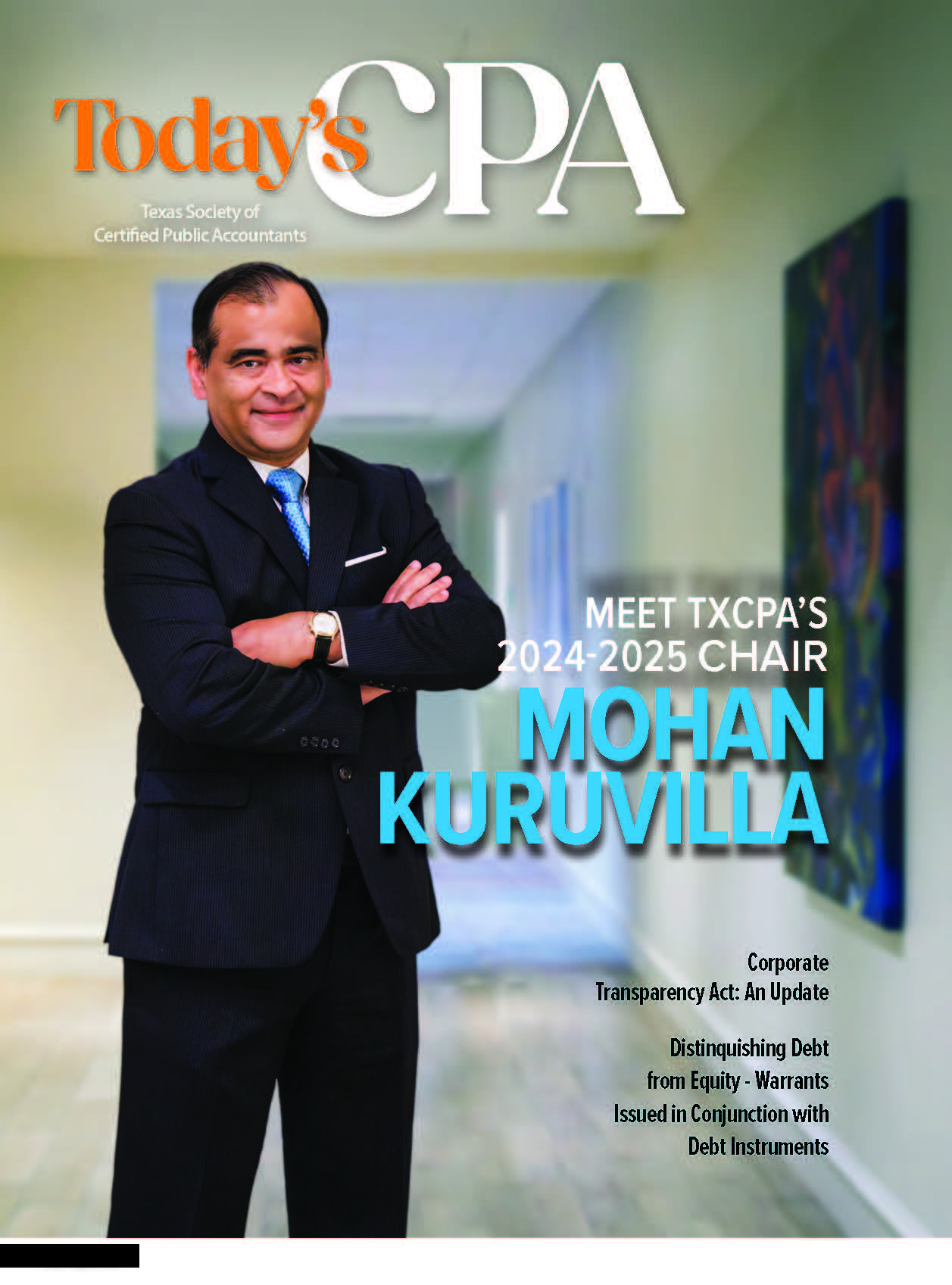
CHAIR
Mohan Kuruvilla, Ph.D., CPA

PRESIDENT/CEO
Jodi Ann Ray, CAE, CCE, IOM

CHIEF OPERATING OFFICER
Melinda Bentley, CAE

EDITORIAL BOARD CHAIR
Jennifer Johnson, CPA

MANAGER, MARKETING AND COMMUNICATIONS
Peggy Foley
pfoley@tx.cpa

MANAGING EDITOR
DeLynn Deakins
ddeakins@tx.cpa

COLUMN EDITOR
Don Carpenter, MSAcc/CPA

DIGITAL MARKETING SPECIALIST
Wayne Hardin, CDMP, PCM®

CLASSIFIEDS
DeLynn Deakins

Texas Society of CPAs
14131 Midway Rd., Suite 850
Addison, TX 75001
972-687-8550
ddeakins@tx.cpa


Editorial Board
Derrick Bonyuet-Lee, CPA-Austin;
Aaron Borden, CPA-Dallas;
Don Carpenter, CPA-Central Texas;
Rhonda Fronk, CPA-Houston;
Aaron Harris, CPA-Dallas;
Baria Jaroudi, CPA-Houston;
Elle Kathryn Johnson, CPA-Houston;
Jennifer Johnson, CPA-Dallas;
Lucas LaChance, CPA-Dallas, CIA;
Nicholas Larson, CPA-Fort Worth;
Anne-Marie Lelkes, CPA-Corpus Christi;
Bryan Morgan, Jr, CPA-Austin;
Stephanie Morgan, CPA-East Texas;
Kamala Raghavan, CPA-Houston;
Amber Louise Rourke, CPA-Brazos Valley;
Shilpa Boggram Sathyamurthy, CPA-Houston, CA
Nikki Lee Shoemaker, CPA-East Texas, CGMA;
Natasha Winn, CPA-Houston.

CONTRIBUTORS
Melinda Bentley; Kenneth Besserman; Kristie Estrada; Holly McCauley; Craig Nauta; Kari Owen; John Ross; Lani Shepherd; April Twaddle; Patty Wyatt