March 05, 2026
Bridging the Skills Gap in ESG - How CPAs Can Prepare for a Growing Service Area



By Tamara K. Kowalczyk, Ph.D.
As CPAs are called upon to assist companies with measuring, reporting and managing Environmental, Social and Governance (ESG) performance, the demand for professionals with education and training in this area is increasing. In response, public accounting firms are investing millions of dollars to develop the capability to provide ESG services, including analysis, reporting and assurance (Boudreau, 2022; Verschelden, 2025). In addition, advances in AI-augmented ESG monitoring and reporting tools are expected to reshape how companies measure and justify ESG spend, potentially increasing software and analytics budgets. (Forbes, 2025)
Working in this area requires specific skills and knowledge to serve in roles such as ESG auditors, analysts and controller positions. While many accounting academic programs are beginning to incorporate sustainability topics into existing or new courses, a skills gap remains for early-career professionals needed to serve in ESG-related roles. Competency in this area is also essential for experienced accountants, as measuring and reporting nonfinancial ESG data is becoming increasingly expected of CPAs (Coffey, 2022; Poveda, 2024).
While several required competencies are those gained in accounting academic programs, others may require additional actions to optimize opportunities for ESG roles. This article outlines the key competencies required for these new roles and explains how CPAs can develop them to prepare for ESG-related careers.
Key ESG Competencies Needed
To prepare for the opportunities in ESG-related accounting roles, CPAs should have the following key competencies.
Core accounting knowledge: Traditional accounting skills in measuring, reporting and managing financial data are essential in professional accounting. Applying these skills to ESG-related costs, such as climate-related supply chain disruptions, helps assess financial risk and understand impacts on revenue.
Navigating the language of ESG: Working in ESG requires familiarity with commonly used terms that are often misunderstood. Corporate Social Responsibility (CSR) and the triple bottom line (TBL) laid the groundwork by emphasizing environmental and social accountability alongside financial results. ESG goes further by elevating accountants’ role in providing sustainability metrics that help investors assess financial risks from non-financial factors. Clear understanding of these distinctions supports effective communication about reporting and disclosure needs.
Familiarity with ESG reporting frameworks and standards: Since the launch of Global Reporting Initiative standards in 2000, sustainability reporting has expanded and is increasingly subject to external assurance, requiring familiarity with reporting frameworks and standards. New ESG disclosure requirements – such as SEC climate rules, the EU’s CSRD and California’s climate mandate – are also increasing demand for CPAs to provide ESG disclosure services.
Proficiency with data analytics and digital tools (including AI): Accountants increasingly assist in measuring and managing non-financial ESG data, such as emissions, resource use and workforce safety, to support strategic decisions. Proficiency with AI tools is also becoming essential, as AI enables more efficient collection and analysis of large, diverse ESG datasets.
Linking ESG risks with financial impact: Whereas accountants are trained to recognize traditional financial risks, the financial impacts of ESG factors such as climate change, supply chain disruption, human rights and reputation can be less clear. Scenario planning is therefore critical to ESG risk analysis and strategy.
Interdisciplinary collaboration and communication: Sustainability has long been an interdisciplinary concept, requiring collaboration among environmental scientists, technologists, HR professionals, and legal teams to measure, report and manage ESG performance. ESG roles demand the ability to navigate differing viewpoints and recognize that conflicting perspectives can still lead to shared solutions. CPAs must be able to communicate and collaborate across disciplines to prevent miscommunication.
Global and cultural awareness: Sustainability issues such as climate change and human rights in supply chains are global risks that influence business strategy. CPAs should understand how cultural and regional differences affect ESG risk management, such as reputational challenges tied to limited sourcing options and child labor concerns.
Actions CPAs Can Take Now
Because most early-career professionals have limited opportunities for sustainability education while in college, the ESG skills gap must be addressed through employer development programs or self-directed learning. For CPAs interested in working in ESG roles, there are several ways to get prepared, even without prior academic training.
Learn key sustainability frameworks: Review sustainability reports and the frameworks behind them, including:
- Global Reporting Initiative (GRI)
- Sustainability Accounting Standards Board (SASB)
- International Sustainability Standards Board (ISSB)
- Corporate Sustainability Reporting Directive (CSRD)
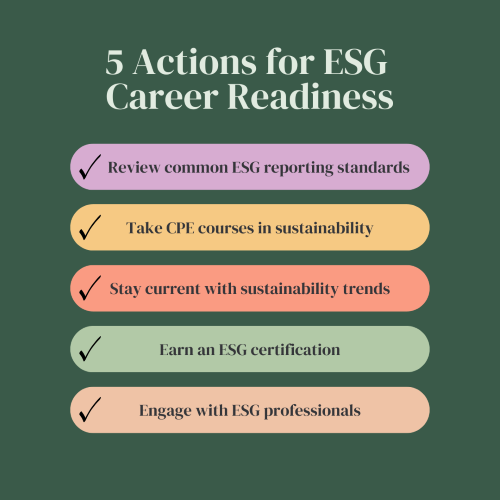
Pursue relevant CPE and use professional association resources: Take courses in sustainability, environmental science, climate change literacy or accounting for nature to better understand ESG metrics like emissions, water use and waste; see TXCPA’s ESG-related programs available on the AcctoFi learning site at www.acctofi.com and climate and sustainability/ESG courses offered by AICPA at www.aicpa-cima.com.
Monitor academic and workforce trends: Some accounting programs now offer sustainability accounting courses to prepare students for ESG roles.
Stay current on ESG developments: Follow sources such as Trellis (formerly GreenBiz), ESG News, AICPA and Big Four firm websites.
Consider ESG certifications: Credentials such as the AICPA Fundamentals of ESG Certificate, GRI Professional Certification or IFRS Fundamentals of Sustainability Accounting (FSA) can strengthen ESG career readiness.
Engage with ESG professionals: Connect with ESG and sustainability professionals through LinkedIn groups, webinars and trade associations to learn more about this service area and identify potential career paths. Sustainability Professionals and Sustainability Reporting & Communications are LinkedIn groups that offer a platform for connecting with ESG professionals and exploring job opportunities.
Preparing for the Future
As demand for ESG services grows, CPAs can close the skills gap by building key competencies needed for providing these services in public accounting firms and private industry.
Similarly, engaging with sustainability professionals through LinkedIn groups, webinars and conferences can strengthen key competencies. By taking steps now, CPAs can position themselves for new roles in this exciting field of accounting.
About the Author: Tamara K. Kowalczyk, Ph.D., is Professor of Accounting at Appalachian State University. Contact her at kowalczykt@appstate.edu.

References
AICPA-CIMA (2025). Climate & Sustainability/ESG Resources, CPE & Learning, available at https://www.aicpa-cima.com/topic/sustainability-esg
Boudreau, C. (2022) “The Big Four accounting firms need sustainability experts – and are investing big in training to get them,” Business Insider, June 2022, https://tinyurl.com/26sfsh2j
Coffey, S. (2022) “Building skills around ESG is essential,” AICPA & CIMA Insights Blog, Nov. 2022, Available at: https://www.aicpa-cima.com/professional-insights/article/building-skills-around-esg-is-essential
Marr, B. (2025) "5 ESG Trends That Will Shape Business in 2026" Forbes, October 2025, available at https://www.forbes.com/sites/bernardmarr/2025/10/17/5-esg-trends-that-will-shape-business-in-2026/?utm_source=chatgpt.com
MasterCPE (2025). “Course Information: Climate Change Accounting and Sustainability Reporting” Available at: https://www.mastercpe.com/product/climate-change-accounting-and-sustainability-reporting/
Poveda, M. (2024). “The accounting profession's role in ESG reporting,” Accounting Today, Sept 2024. Available at: https://www.accountingtoday.com/opinion/the-accounting-professions-role-in-esg-reporting
Verschelden, A. (2025) “Accelerating success in your ESG practice.” Good.Lab, July 2025. https://tinyurl.com/37rxwumu
Thanks to the Sponsors of Today's CPA Magazine
This content was made possible by the sponsors of this issue of Today's CPA Magazine: