March 05, 2026
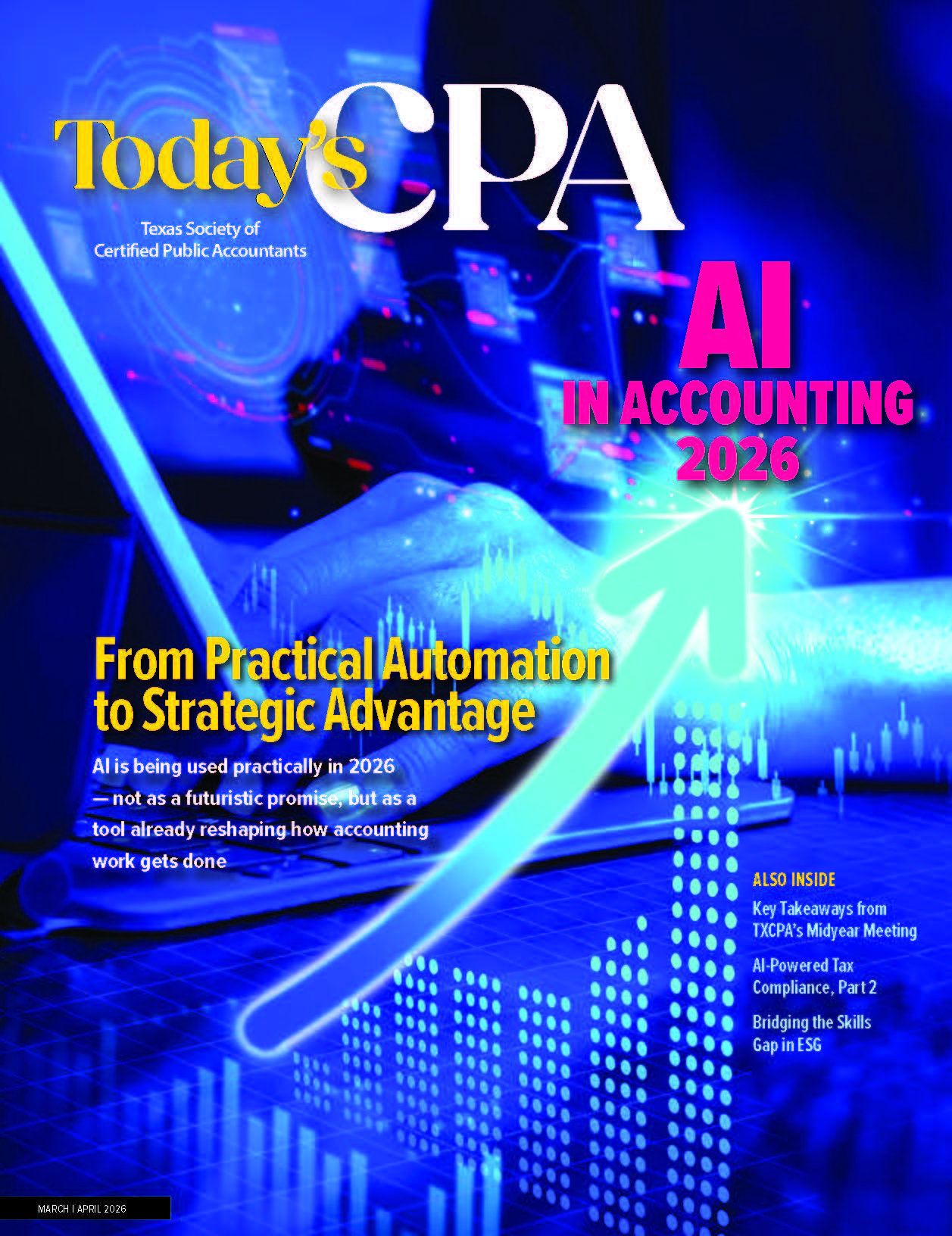
AI in Accounting 2026: From Practical Automation to Strategic Advantage



By Randy Johnston
Artificial intelligence is no longer an emerging concept for the accounting profession. In 2026, AI will be embedded into the daily workflows of accounting firms, businesses, government entities, and nonprofit organizations. What has changed most dramatically is not the presence of AI, but the way it is being applied. CPAs are moving past experimentation and toward disciplined, real-world use cases that improve efficiency, quality and professional judgment.
This article focuses on how AI is being used practically in 2026 - not as a futuristic promise, but as a tool already reshaping how accounting work gets done. The emphasis is on outcomes: fewer manual steps, clearer reviews, better insights, and more time spent on analysis and communication, not on manual processes. All the concepts discussed in this article will be covered in sessions at TXCPA's 2026 Technology Conference.
Early AI adoption in accounting focused on assistance, such as drafting emails, summarizing research or interpreting standards. In 2026, the most impactful systems go further. They initiate actions, monitor conditions and advance work automatically within defined rules. This approach is often described as Agentic AI, but in practice, it simply means that systems no longer wait to be told what to do next.
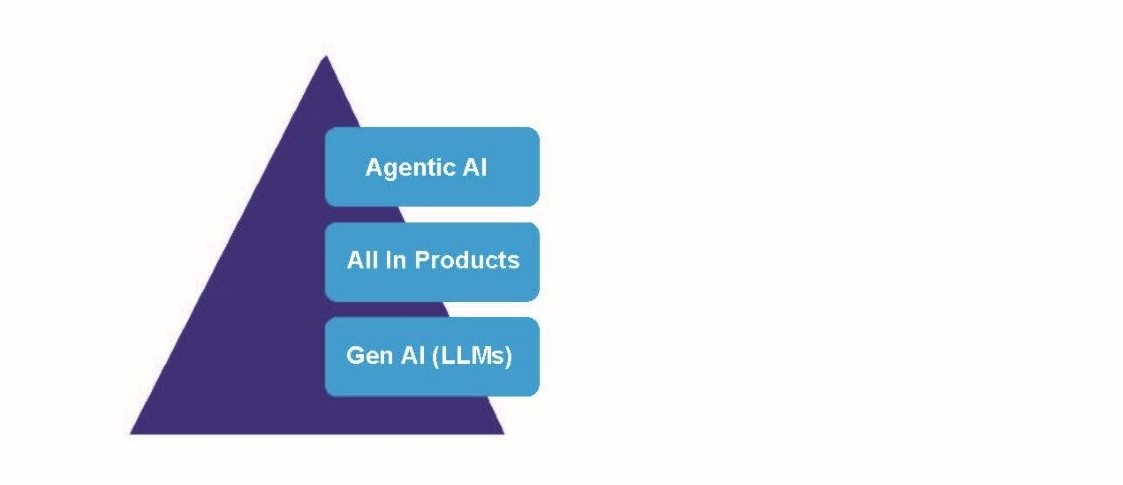
The best way to picture AI today is in three levels:
1. Large Language Models (LLMs) and Generative AI (GenAI) tools such as ChatGPT, Copilot365, Gemini, and Claude,
2. Supplemented by our standard AI-enabled technology stack, and
3. Workflows and tasks empowered by Agentic AI.
Consider AI in accounting with the following diagram:
For CPAs, AI functions as workflows that automatically collect documents, extract relevant data, validate completeness, flag exceptions, and produce review-ready work products. AI shifts the professional’s role toward judgment, interpretation and explanation.
Governance Becomes Operational
In 2026 and beyond, AI governance will no longer be theoretical, despite the minimal regulation of AI in the U.S. Clients, regulators and insurers expect firms to demonstrate control over how AI is used. Practical governance includes knowing where data goes, how long it is retained, and how AI-generated outputs can be reviewed and explained.
Firms that treat governance as part of daily operations – rather than a policy document – are better positioned to manage risk and maintain trust.
The Workforce Reality: New Skills, Same Responsibility
AI is reshaping staffing models, particularly at junior levels. Routine tasks require fewer hours, while demand increases for professionals who can oversee workflows, supervise AI outputs and communicate insights. These “digital seniors” blend accounting expertise with process awareness and technology fluency.
Training is increasingly hands-on and scenario-based. Firms are discovering that buying technology without investing in applied learning limits returns.
Government and Nonprofits: Reducing Administrative Burden
Government agencies and nonprofit organizations face increasing reporting requirements with limited staffing. AI is being used to automate grant reporting, improve audit readiness and reduce dependence on institutional memory. Document understanding and workflow automation are especially valuable in environments with high turnover and compliance demands.
Tax Practice: From Data Collection to Exception Review
Tax preparation is one of the clearest examples of AI delivering measurable value. In 2026, leading firms must structure tax work as an end-to-end process rather than a seasonal scramble. AI tools ingest source documents, apply prior-year context and prepare draft returns that are ready for professional review.
Examples of tools being used in practice include Black Ore’s Tax Autopilot, Filed and Magnetic. These platforms focus on automating intake, classification and preparation, while leaving review and sign-off squarely in human hands.
Mainstream platforms are also embedding AI directly into familiar environments. Thomson Reuters’ Checkpoint Edge with CoCounsel supports research, drafting and document analysis inside established tax workflows.
The result is not “push-button” tax preparation. Instead, CPAs spend less time assembling information and more time evaluating unusual items, resolving ambiguity and advising clients on implications.
Audit: AI That Supports Quality, Not Shortcuts
Audit adoption of AI has been more deliberate and for good reason. The most successful AI-based audit applications emphasize explainability, traceability and evidence quality.
AI is being used to extract key information from contracts, link source documents directly to workpapers and identify anomalies earlier in the audit cycle. Tools such as DataSnipper, Trullion, TABS, and Auditor Intelligence are widely used to support these objectives.
The practical benefit is earlier risk identification and more focused professional skepticism. Importantly, AI outputs are treated as inputs to the firm’s quality control system – not replacements for professional judgment.
Client Accounting Services: Automation Rewards Discipline
Client Accounting Services continues to grow, but AI is amplifying the gap between scalable and fragile practices. In well-run CAS practices, AI automates routine reconciliation and categorization, flags exceptions, and generates dashboards and alerts rather than static monthly reports.
Common tools include MakersHub.ai, Vic.ai, Botkeeper, and Dext. For financial reporting and forecasting, tools such as Fathom and Syft Analytics are frequently layered on top.
The firms benefiting most from AI in CAS are those with clearly defined service tiers, standardized workflows and consistent review expectations. AI does not fix weak processes – it exposes them.
Advisory and Forecasting: Preparing the Conversation
One of the most practical uses of AI is preparing advisory conversations before they happen. AI tools now routinely generate ratio analysis, variance explanations, draft forecasts, and scenario models ahead of client meetings.
Platforms such as 4ImpactData, Aider, SOBI Analytics, and Changing the Face of Finance (CFOF) support this shift by assembling insights that professionals can interpret and discuss. The CPA’s value lies in framing the discussion, explaining tradeoffs and guiding decisions.
What to Do Next
For CPAs evaluating AI in 2026, the practical steps are clear:
- Review workflows before buying new tools;
- Start with document-heavy processes where gains are measurable;
- Require review-ready outputs with citations;
- Reduce tool sprawl in favor of integrated platforms;
- Treat training time as a strategic investment.
Artificial intelligence does not replace professional judgment. It makes clear where judgment adds value – and where processes need improvement.
From Experiment to Execution: AI Becomes an Operational Imperative
AI in 2026 is no longer about novelty. It is about operations and execution. Firms and organizations that apply AI deliberately deliver higher quality work with less friction and greater consistency. Those that do not may find that AI’s most significant impact is simply revealing inefficiencies they can no longer ignore.
About the Author: Randy Johnston has been an entrepreneur, technologist and teacher for most of his career. He has helped start and run many businesses, founded Network Management Group, Inc. and owns half of K2 Enterprises. K2 has produced a multi-day technology conference for the Texas Society of CPAs for over 20 years. He is best known for his early and ongoing expertise in networks, accounting software, paperless processes, and CPA Firm technology. Subscribe to a weekly podcast on technologies from The Accounting Technology Lab sponsored by CPA Practice Advisor or from Apple Podcasts.

How the Technology Platform Changing the Face of Finance Uses AI to Elevate Advisory WorkFounded by TXCPA Houston member Arthur Forbus, Changing the Face of Finance (CFOF) is a platform focused on finance leadership, strategy and outcomes, emphasizing the integration of people, process, technology, and data. At CFOF, AI is used as a practical tool to enhance, not replace, professional judgment. Across advisory services, finance transformation and thought leadership, CFOF applies AI in three primary ways:
AI helps quickly synthesize large volumes of information – including research, accounting guidance, meeting notes and client inputs – into clear, structured perspectives. This allows more time to be spent on evaluating implications, identifying risks and applying professional judgment where it matters most. AI is also used to refine communication across diverse finance audiences. By pressure-testing explanations and improving clarity and tone, AI supports more effective messaging for CFOs, boards and cross-functional leaders. All outputs are reviewed and finalized by a human, ensuring accuracy and accountability. Most significantly, AI enables advisory conversations to begin at a higher level. AI does not make decisions, sign opinions or replace ethical responsibility. Central to the work is professional skepticism, context and accountability. For the accounting profession, the opportunity with AI is not automation alone, but elevation – creating space for higher-value advisory, leadership and strategic impact. Source: Arthur Forbus, Changing the Face of Finance (CFOF) |
How 4impactdata Uses AIHow 4impactdata Uses AI 4impactdata embeds AI at the center of its Business Guidance System, helping accounting and CAS teams move from static reporting to proactive advisory. Its Codified Wisdom™ Decision Intelligence engine captures proven advisory patterns and applies them to client data in real time. The platform continuously monitors financial metrics, flagging early warning signs like liquidity declines, margin pressure or slowing payments. Predictive models highlight emerging risks and opportunities before they appear in traditional month-end reports. Instead of just summarizing results, the system delivers prioritized, tailored recommendations that guide advisors on the most impactful next steps. Automated data standardization ensures clean inputs, enabling reliable insights at scale. The outcome: greater advisory capacity, earlier intervention and more strategic, forward-looking client conversations. Source: 4impactdata |
Inside a Small Dallas Firm’s Expanding Use of AIDASG LLC, a Dallas-based tax and accounting firm, is showing how small practices can fully integrate artificial intelligence into daily operations to boost accuracy, efficiency and client results. The firm uses AI throughout its federal tax preparation and compliance services to improve calculation accuracy, automatically identify deductions and credits, and monitor ongoing changes in federal tax rules. These tools also forecast quarterly liabilities and generate predictive insights to help clients plan ahead. Beyond tax work, DASG applies AI to bookkeeping, financial reporting, payroll and cash-flow management. Real-time analytics uncover financial trends and provide clients with up-to-date insights through secure cloud systems. DASG’s approach highlights a broader industry shift: using AI not just to automate tasks, but to elevate the quality and responsiveness of tax and accounting services. Source: DASG LLC |
A New Era of AI-Driven Accounting and Advisory ServicesAs artificial intelligence takes hold across the professional services landscape, Whitley Penn is steadily expanding its use of AI across audit, tax and advisory services, transforming traditional processes and improving client value. AI now allows auditors to analyze nearly all client data instead of relying on sampling, leading to faster anomaly detection, greater accuracy and deeper insight into risks such as errors or fraud. AI-based analytics have revealed patterns like recurring revenue declines and have sped up complex tasks such as benefit plan audits and unrecorded liability testing. Internally, the firm supports adoption through a trained “super champion” team that helps integrate new tools into daily work. Beyond internal use, Whitley Penn’s Digital Services practice helps clients build AI strategies and implement automation. By embracing full-population analytics and intelligent automation, the firm enables professionals to spend more time interpreting insights and advising clients in an increasingly data-driven environment. Source: Whitley Penn |
Thanks to the Sponsors of Today's CPA Magazine
This content was made possible by the sponsors of this issue of Today's CPA Magazine: