May 08, 2026
A Refresher on Auditor Independence: Best Practices Every CPA Should Know



The Importance of Auditor Independence
By Ashley Bentley, Ed.D., CPA
Auditor independence is at the heart of public trust in the accounting profession. It is the foundation upon which the credibility of the audit opinion rests. Auditors are hired by organizations to provide an unbiased 3rd party assessment of the reliability of information. It is the sole reason external stakeholders can confidently rely on the financial statements provided by entities.
Without independence, the auditor’s judgement may be impaired, resulting in an invalid audit opinion. Still yet, practitioners continue to violate independence rules, whether intentionally or unintentionally, jeopardizing the reputation of the profession.
The AICPA Code of Professional Conduct describes independence as requiring freedom from influences that compromise professional judgement. It is bifurcated into two components: Independence in Fact and Independence in Appearance.
Independence in Fact is defined as “The auditor’s mental objectivity and impartiality when performing an engagement.” Independence in Appearance is defined as “The avoidance of situations that a reasonable and informed third party, aware of all relevant facts, would perceive as impairing the auditor’s objectivity.” The first being the auditor’s own state of mind, the latter being an external party’s perception of the auditor’s independence.
AICPA’s independence rules apply to all CPAs involved in auditing or other attestation services provided to both privately held and publicly traded companies. In addition to AICPA, those conducting audits of publicly registered companies must comply with the independence standards established by the SEC and PCAOB.
This article provides a practical refresher on auditor independence, highlighting the most common pitfalls, as well as the most recent inspection findings of PCAOB. The article also offers a discussion of best practices every CPA should consider to maintain their independence and avoid violations.
General Threats to Auditor Independence
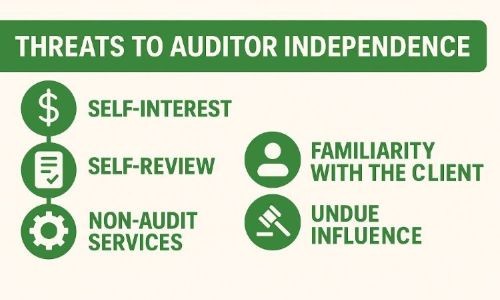
Although independence is a cornerstone of the profession’s Code of Professional Conduct, it continues to be a misunderstood area and/or misapplied by CPAs. According to an article in the Journal of Accountancy, auditors all face similar threats to maintaining their independence, sometimes without even noticing (Ference, 2023).
One of the most common threats noted in the article is self-interest. This can stem from the auditor having a financial interest in or significant business relationship with the client. It could even arise when the auditor’s compensation is based on client fees or maintaining client relationships.
Self-review is also a common pitfall for auditors, particularly those of smaller, private entities. Clients will frequently ask for assistance in the preparation of the financial information. In an effort to be helpful, auditors often default to being accommodating, not considering the impact on independence. Providing non-audit services that result in the auditor being the decision maker or the source of the documentation used to support the financial statements being audited is prohibited. Performing an audit of your own work impairs your ability to remain unbiased.
Another common threat to independence is familiarity with the client (Ference, 2023). After serving as a company’s auditor for an extended period of time, it is only natural to develop professional relationships with the employees of the company. While not a direct violation of the independence rules, auditors can become too trusting and allow these relationships to impact their professional skepticism and potentially accept less than persuasive evidence.
Auditors may also feel intimidated by the client to provide a clean audit opinion. For example, the client may threaten that the continuation of the audit engagement is contingent on the results of the audit. This undue influence may result in the auditor’s inability to perform the audit without compromising their professional judgment.
While avoiding these common pitfalls may sound simple, independence rules are not always clear cut. Without bright line rules, it often requires the judgement of the auditor to interpret and apply the standards to their particular situation.
PCAOB Inspection Observations Related to Auditor Independence
To comply with the Sarbanes-Oxley Act, PCAOB inspects audit firms involved in auditing publicly registered companies on an annual basis. The scope of the inspection includes compliance with SOX and the rules of the SEC and PCAOB, as well as professional standards.
Given the importance of independence and history of recurring violations, PCAOB views independence compliance as a high priority when conducting these reviews. In September 2024, PCAOB issued a Spotlight Report that highlighted the specific independence issues observed in conjunction with their most recent inspections and emphasized the need for auditors to be mindful of the problematic areas. See Figure 1.
Figure 1. PCAOB Inspection Observations – Auditor IndependenceThe PCAOB Spotlight Report highlighted the following areas of concern. Audit Committee Communication and Pre-Approval of Service
Personal Independence Compliance
Prohibited Financial Relationships
Non-Audit and Tax Services
Employment Relationships
Engagement Letter Issues
Firm Policies and Quality Control
Partner Rotation
Restricted Entity List
Fees and Financial Conflicts
These observations emphasize the importance of strong quality control systems, timely communication, and proactive monitoring to maintain both independence in fact and appearance. Click here to read more details on each of these areas. |
Best Practices to Mitigate the Risk of Independence Violations
There are a multitude of safeguards that companies can implement to lessen the chance of independence violations, starting with firm leadership. It is imperative that the tone at the top establishes the importance of independence. This process begins with a robust framework of policies and procedures, supported by clearly defined disciplinary measures for any violations.
Strengthen Training and Oversight
At minimum, firms should require general ethics and independence training, as well as compliance reporting, on an annual basis. PCAOB identifies a valuable way of strengthening this process through mandatory individualized meetings, during which firm personnel consult with independence specialists to ensure all financial interests are properly disclosed.
Independence representations should be refreshed more frequently, such as semi-annually or quarterly, to ensure the information remains current. Firms should also consider offering enhanced training for personnel in response to certain life events (i.e., promotion or marriage) that trigger reassessment of independence.
Leverage Technology
Utilizing technology-based tools can help audit firms address potential independence issues more efficiently and effectively. For example, rather than manually reviewing and comparing personnel’s reported financial holdings with their billable time to confirm they have no financial interest in clients they audit, software can efficiently cross-check these lists to identify any independence violations.
Firms can leverage regularly updated financial broker data systems to more consistently compare personnel financial interests against the firm’s restricted list. Rather than waiting until personnel update their information, these automated feeds can provide real-time alerts to management regarding any identified violations.
Firms may also consider the use of personal trading compliance software (example: MyComplianceOffice) to prevent independence violations on the front end. Personnel enter a potential investment and the tool provides either a “cleared” or “denied” response, based on the firm’s restricted entity list (which can also be updated by the software), essentially blocking conflicts of interest immediately.
Enhance Engagement-Level Controls
In addition to the overall firm policies, having engagement level safeguards is beneficial. Independence confirmations are a critical step for engagement team members. Prior to performing work on a client, auditors should complete an independence confirmation to ensure there are no conflicts of interest.
However, as noted by PCAOB, teams often fail to obtain confirmations from all team members (or assess the need for a confirmation). Teams should monitor charge codes and send targeted compliance reminders to personnel who have billed hours but not yet completed an independence confirmation. Most independence reporting software can automatically send system-generated emails, based on set criteria.
Promote Rotation and Objectivity
Use of a standardized engagement letter is also recommended by PCAOB to avoid the inclusion of indemnification clauses, contingent fees or prohibited services. It is the responsibility of the lead audit partner to ensure the letter is signed and Audit Committee pre-approval has been obtained before beginning work on the engagement. Periodic rotation of all engagement team members, not just partners, is also a best practice to mitigate the risk of familiarity.
Each audit team should consider what independence means on an engagement level. Independence in appearance can be tricky, as it is both subjective and contextual. The audit is performed on behalf of the users, and the appearance of independence is in the “eye of the beholder” and must be assessed through their lenses. An auditor may fully comply with independence regulations and yet still fail to appear independent to certain reasonable users who perceive that the circumstances compromise the objectivity of the auditor.
Thus, auditors should try to understand what financial statement users would deem as an independence issue and evaluate if their actions and/or relationships would weaken the confidence of the users.
Emphasize Individual Responsibility
Lastly, it is the responsibility of each individual practitioner to maintain their independence. This begins with remaining mindful of conflicts of interest, maintaining professional skepticism and avoiding biases. Auditors should be aware of all their financial interests (including those of their immediate family members), keep detailed records and documentation, and provide timely updates to their firm.
It is also crucial to disclose all business and employment relationships. If offered a position with the client or seeking employment, they should refrain from participating in audit procedures until the issue is resolved. To further address this potential issue, some firms have arrangements with their clients that mandate a “cooling off” period for all engagement team members, not just those taking a financial reporting oversight role.
Put simply, employees who want to work for a company they audit must rotate off the engagement for a minimum amount of time before accepting any type of position with that client.
Key Takeaways
Although the landscape of the profession is evolving, the importance of auditor independence remains unchanged. Independence is still the cornerstone of auditor credibility. Without it, the audit opinion holds no value.
Audit professionals must remember that independence is a mindset, not a checklist. They must make a conscious effort to maintain independence each and every day, periodically revisiting and refreshing their understanding of independence policies to ensure compliance. By doing this and implementing the best practices provided, auditors will strengthen their objectivity and preserve public trust.
Related CPE:2026 Single Audits and Governmental Accounting and Auditing Conference, September 24-25 2025 Accounting and Auditing Update, May 19 Independence Requirements for Auditors, May 19 (30 offerings from May 2026 to June 2027) |

About the Author: Ashley Bentley, Ed.D., CPA, is an Assistant Professor and the Blackburn, Childers and Steagall Faculty Fellow in the Department of Accountancy at East Tennessee State University. She can be reached at bentleyab@etsu.edu.
References
American Institute of Certified Public Accountants (AICPA). (2014). Code of Professional Conduct. https://pub.aicpa.org/codeofconduct/Ethics.aspx
Ference, S.B. (2023, December 1). “Audit independence threats and malpractice claims.” Journal of Accountancy. https://www.journalofaccountancy.com/issues/2023/dec/auditor-independence-threats-and-malpractice-claims/
Public Company Accounting Oversight Board (PCAOB). (2024). Inspection Observations Related to Auditor Independence. https://pcaobus.org/resources/staff-publications?utm_source=hs_email&utm_medium=email&_hsenc=p2ANqtz-9dJrJ9uLvqx9CinqhI0g2tVyLbJ8-8dfY4VApW4vIdNNQhcoNYpjHhNSPgtve505y8gXBr
Thanks to the Sponsors of Today's CPA Magazine
This content was made possible by the sponsors of this issue of Today's CPA Magazine: