January 13, 2026

AI-Powered Tax Compliance, Part 1: How Machine Learning is Revolutionizing Sales and Use Tax

By Karina Kasztelnik, Ph.D.

Sales and tax compliance have grown more complex in the Wayfair era as states expand economic nexus rules and update guidance at a rapid pace. Traditional rule-based engines struggle with scale, ambiguity in product descriptions and cross-system data quality issues.

In this first article of a two-part series, we explain why machine learning (ML) complements rules to improve consistency, speed and auditability in sales and use tax operations. We outline the data and governance foundations for adopting ML and present Case Study 1: Automated Nexus Detection, showing how a hybrid rules-plus-ML approach pulls forward registrations, reduces manual review time and strengthens evidence for auditors.

Part 2 of the series will continue with taxability classification, error management via confusion matrices and thresholds, and filing operations.

Blending Bright-Line Rules with Machine Learning

Economic nexus thresholds and evolving state guidance have turned sales and tax into a high-frequency, data-intensive process. Teams must detect exposure, classify products correctly and file on time   across jurisdictions, channels and changing catalogs. Hard-coded rules remain essential for bright lines, but they are brittle when data are messy or when workloads spike.

ML adds lift where scale and ambiguity dominate. By learning from labeled history and pairing predictions with human review and immutable logging, ML helps prioritize effort, standardize decisions and create defensible audit trails.

This article frames the modern tax stack and demonstrates a pragmatic first step   nexus detection   that combines rules for certainty with ML for triage and foresight. (Part 2 will extend this foundation to taxability classification and filing at scale.)

Case Study 1: Automated Nexus Detection

A mid-sized e-commerce retailer specializing in health and wellness products experienced substantial growth during the pandemic. Leadership quickly recognized a gap in visibility regarding when their activities would trigger economic nexus obligations.

To address this issue, the company partnered with a tax technology provider to implement an ML-based nexus detection system (Bloomberg Tax (n.d.)). This solution aggregated transactional data from order management, payment processors and shipping carriers. Using supervised learning, the model was trained to identify patterns that indicated the threshold for nexus had been crossed, including cumulative gross receipts and transaction counts.

Within six months, the ML model successfully identified four additional states where economic nexus had been triggered but not yet registered. As a result, manual review time was reduced by 60 percent, allowing the company to register proactively and avoid potential penalties (Gartner, 2024).

Main Points from the Case Study: ML enables continuous monitoring and provides early warnings regarding nexus obligations, relieving tax teams from the burden of manually reviewing thousands of transactions.

Nexus Detection Workflow Using ML

ML can help companies know when they must register to collect sales tax in a state. At the start of the process, all the company s sales and shipping data are gathered from different systems, like order records and shipping logs. This information is combined and cleaned up so that it is consistent and easy for the ML program to read.

The ML system aggregates sales and shipment data, trains on historical thresholds and generates monthly risk reports for proactive registration as follows:

Data Sources –> Transaction Data (Sales, Shipments) –> Data Aggregation and Cleansing –> ML Model (Supervised Learn) –> Nexus Risk Report (State Thresholds Exceeded, Potential Exposure) –> Tax Team Review and Registration

Next, the cleaned data is fed into the ML model. This model has been trained to recognize patterns that signal when sales or transactions in a state are getting close to the legal threshold that requires registration. For example, some states set a dollar amount or number of transactions that trigger tax obligations.

The model uses the company s historical data to learn what those patterns look like over time. Every month, the machine learning system checks the latest transactions against these thresholds. When it sees that a state s threshold has been crossed or is about to be crossed, it automatically creates a risk report.

This report highlights which states need attention and shows exactly why the system flagged them. The tax team reviews this report to confirm whether registration is necessary. If needed, they can then register in that state before penalties or interest apply.

By automating this process, the company avoids the risk of missing important deadlines. This system also saves time, because employees no longer have to review thousands of records manually. In short, the workflow helps tax teams stay proactive and confident that they are meeting all sales tax rules.

Advantages of Earlier Nexus Detection

ML doesn't replace bright-line rules in sales and use tax   it amplifies them. In the Wayfair era, exposure detection is as much a volume and timing problem as a legal one. A pragmatic hybrid approach   rules for certainty, ML for scale and prioritization   lets teams spot nexus earlier, focus analyst effort where it matters and preserve decision evidence for auditors.

The Nexus case study shows that even a lightweight model, paired with clear ownership and immutable logs, can reduce manual review time and pull forward registrations without overbuilding a platform.

The path forward is straightforward: start with a time-boxed proof of value, measure lift against last year s outcomes and institutionalize monthly calibration. With this foundation in place, tax teams are ready to tackle the two daily bottlenecks that drive risk and workload   taxability classification and filing   which we address in Part 2 of this series using recall-centric evaluation, human-in-the-loop thresholds and right-sized deployment choices.

Related CPE

2026 Technology Conference

The CFO Series-Artificial Intelligence: A Practical Guide for Financial Leaders and CFOs

Can You Really Do That With AI?


About the Author: Karina Kasztelnik, Ph.D., is Assistant Professor at Tennessee State University in Nashville. Contact her at kkasztel@tnstate.edu.

References

Bloomberg Tax. (n.d.). AI for tax professionals: Understanding the impact and potential. Bloomberg Tax. Retrieved July 4, 2025, from https://pro.bloombergtax.com/insights/tax-automation/ai-for-tax-professionals/

Ernst & Young. (2023). Tax technology and data. EY Global. https://www.ey.com/en_gl/services/tax/technology-data

Gartner. (2024, September 11). Gartner survey shows 58% of finance functions using AI in 2024 [Press release]. https://www.gartner.com/en/newsroom/press-releases/2024-09-11-gartner-survey-shows-58-percent-of-finance-functions-use-ai-in-2024

Galvix. (2023, June 9). Embracing the future: The role of automation in sales tax compliance. Galvix Insights. https://www.galvix.com/article/the-role-of-automation-in-sales-tax-compliance/

KPMG. (2024). Tax Reimagined 2024: Perspectives from the C-suite. KPMG International. https://kpmg.com/us/en/articles/2024/tax-reimagined-report-2024.html

McKinsey. (2025, March 12). The state of AI: Global survey. McKinsey & Company. https://www.mckinsey.com/capabilities/quantumblack/our-insights/the-state-of-ai


Thanks to the Sponsors of Today's CPA Magazine

This content was made possible by the sponsors of this issue of Today's CPA Magazine:

Accounting Biz Brokers

Accounting Practice Sales

Capstan Tax

8amCPA Charge

Goodman Financial


  • SECURE Act 2.0

    SECURE 2.0 and the One Big Beautiful Bill Act

    This article provides a snapshot of the key provisions of the One Big Beautiful Bill Act and retirement provisions in SECURE 2.0. Together, these laws are reshaping retirement planning through new compliance requirements and expanded advisory opportunities, with changes taking effect in 2026 and beyond that call for proactive guidance for clients and employers.
    View Article
  • CPE: Share Repurchases - Playing in the Big Leagues

    Stock buybacks have grown from a once-restricted practice into a dominant way corporations return cash to shareholders. While they return more cash to shareholders than dividends, the financial-reporting and tax risks that large buybacks create must be managed – from negative equity and distorted ratios to rising excise-tax costs.
    View Article
    Tax
  • Volunteer

    Welcoming 2026 with Purpose and Possibility

    Stepping into 2026 brings a wave of opportunity for TXCPA members. This issue of Today’s CPA covers key updates like H.R. 1, SECURE 2.0 and retirement planning, plus insights on AI-driven tax compliance and IRS technology trends. Explore ways to grow, give back, and connect through TXCPA programs and events.
    View Article
  • IRS Use of Artificial Intelligence and Data Analytics to Modernize Operations

    The IRS is rapidly expanding its use of artificial intelligence and data analytics to modernize operations, reshaping compliance, enforcement and taxpayer interactions. From AI-powered chatbots that ease service demands to advanced analytics, the agency is harnessing technology to manage massive data volumes—while walking a careful line between efficiency, fairness and taxpayer trust.
    View Article
    IRS
  • Tax Services

    AI-Powered Tax Compliance, Part 1: How Machine Learning is Revolutionizing Sales and Use Tax

    Business Problem Solved: Companies can struggle to stay on top of complex, high-volume sales and use tax obligations, and this article shows how a hybrid rules-plus-machine-learning approach enables earlier detection, reduces manual review and ensures scalable, auditable compliance.
    View Article
  • Your TXCPA Calendar: Key Dates, Leadership Opportunities and CPE Ahead

    Plan your year with this snapshot of essential events, deadlines and learning opportunities for TXCPA members.
    View Article
    Volunteer
  • fraud

    The Vicious Cycle of Cheating in Accounting: From Students to Practitioners

    Cheating among accounting students and practitioners is increasing and threatens public trust in the profession. Research shows that unethical behavior in school often carries into professional practice. Stronger penalties and dedicated ethics education are needed to break this cycle and reinforce integrity as a core professional value.
    View Article
  • What’s Happening Around Texas - January-February 2026

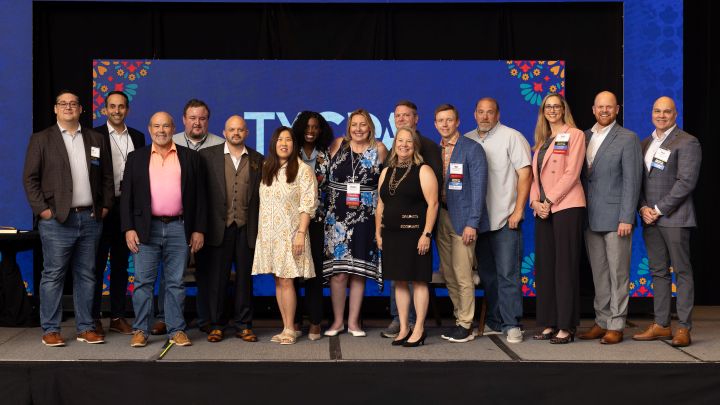
    TXCPA members are making a big impact! During Accounting Opportunities Month and our annual Month of Service, 68 volunteers reached over 3,000 students and supported local charities across Texas. From hosting career workshops and networking events to packing meals and donating toys, chapters showed the power of giving back.
    View Article
    volunteer for my chapter
  • Texas State Board of Public Accountancy

    Turning Challenges into Wins: How TXCPA Advocates for You

    TXCPA delivered major wins for Texas CPAs during the 2025 legislative session, strengthening the profession at a pivotal moment. New legislation expanded pathways to CPA licensure, modernized practice mobility for out-of-state CPAs and reinforced public protection. These successes highlight the growing impact of TXCPA’s advocacy and the critical role of the TXCPA PAC in safeguarding the CPA license.
    View Article
  • TXCPA Thanks Our 2025-2026 Professional Group Membership Program Participants!

    A big thank you to all the firms and organizations that joined or renewed with TXCPA’s Professional Group Membership program. To simplify renewals and maximize your team’s benefits, be sure to explore our group billing option.
    View Article
    Membership
  • TSBPA

    Steadfast Leadership: William Treacy’s 35 Years at the Texas State Board of Public Accountancy

    For three decades, William Treacy has led the Texas State Board of Public Accountancy with one guiding principle: protect the public. His tenure reflects a career defined by integrity, public service and steady leadership in a rapidly changing profession.
    View Article
  • Implications of Section 301 Tariff Actions

    Section 301 tariffs during President Trump’s first term were associated with reducing the U.S. trade deficit with China, though the overall deficit continued to grow. Data suggests tariffs shifted trade flows rather than curbing demand. For CPAs, these insights are key to assessing how renewed tariffs could impact trade patterns, costs and global tax planning.
    View Article
    Transfer pricing
  • Trusted Advisor

    Why Exit Planning Should Be on Every CPA Firm’s Radar

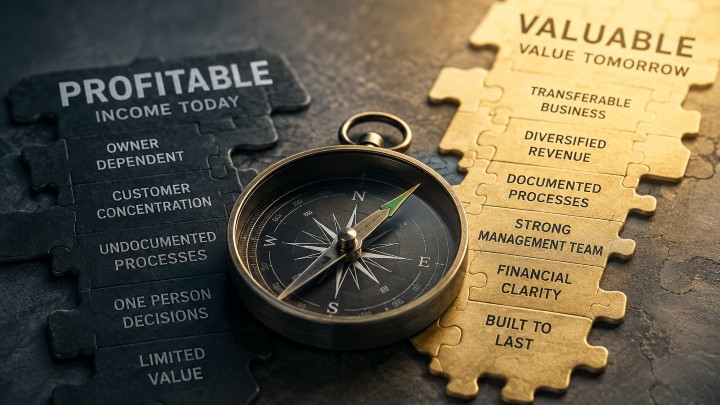
    Exit planning is quickly becoming a high-impact advisory opportunity for CPAs. While many business owners know they will eventually exit, few are truly prepared, and CPAs are ideally positioned to close that gap through trusted relationships and financial insight.
    View Article
  • Governance is Your Growth Engine: Build Value and Outrun Private Equity

    As private equity reshapes the accounting landscape and traditional partnership models strain under talent shortages and succession challenges, strong governance has become the real differentiator. By replacing ad hoc decision-making with clear roles, accountability, performance metrics and disciplined planning, firms can turn chaos into clarity and intention into execution.
    View Article
    Public practice
  • talent retention

    How Employee Resource Groups Can Drive Diversity in an Accounting Organization

    This article dives into how Employee Resource Groups (ERGs) help firms build cultures that attract, engage and retain people by turning inclusion into action. Firms that invest in ERGs create workplaces where employees are more engaged, loyal and likely to thrive.
    View Article
  • Take Note

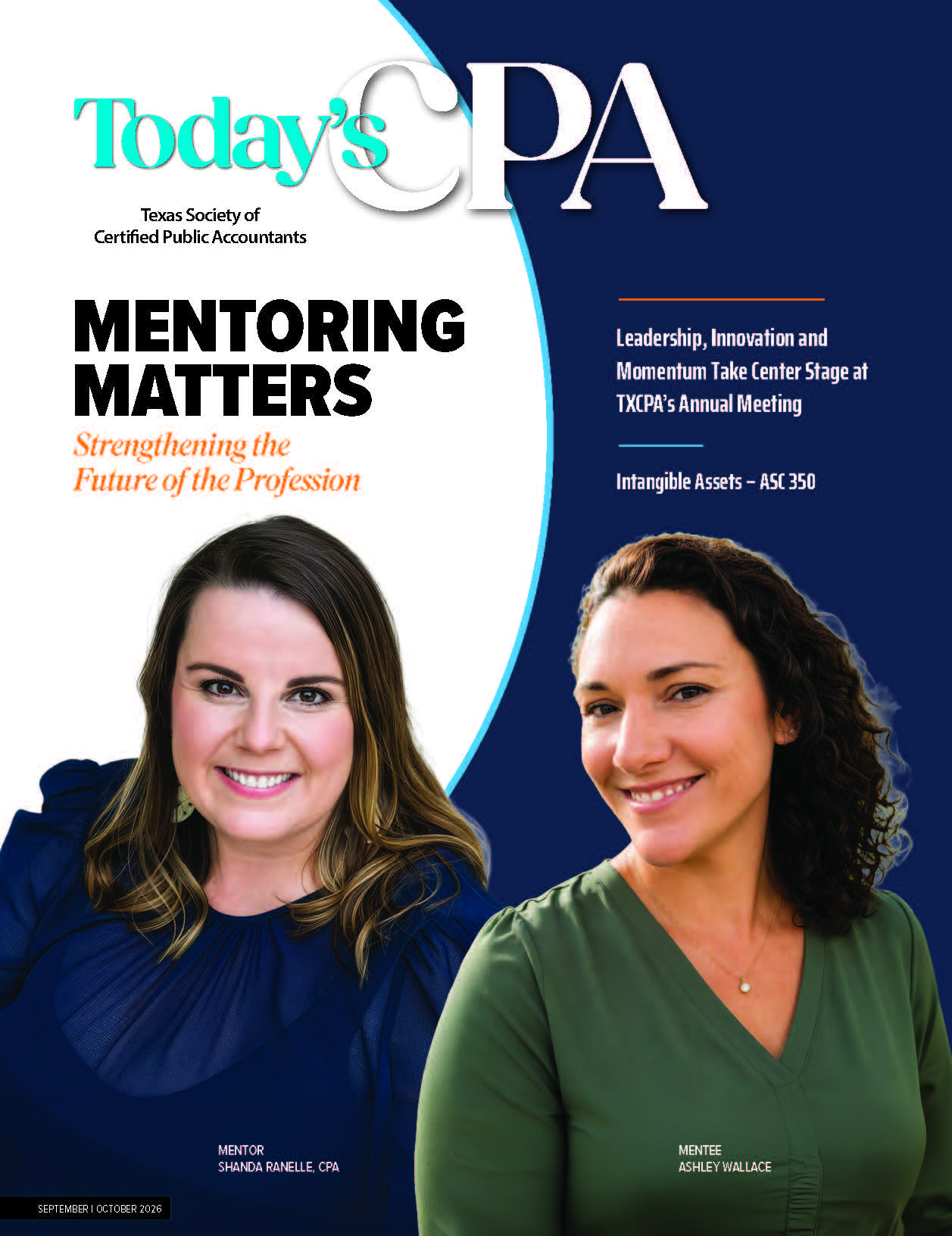
    In this edition of Take Note: 2026 Midyear Leadership Council and Members Meeting; Support Through the Accountants Confidential Assistance Network (ACAN); CGMA® Designation; 2026 CPE Programs; TXCPA’s Career Center
    View Article
    TXCPA online learning
  • Classifieds

    The Classifieds section offers a centralized resource for practice sales, buyers seeking to purchase firms and specialized services. It helps members efficiently connect with opportunities tailored to their professional needs.
    View Article

CHAIR
Mohan Kuruvilla, Ph.D., CPA

PRESIDENT/CEO
Jodi Ann Ray, CAE, CCE, IOM

CHIEF OPERATING OFFICER
Melinda Bentley, CAE

EDITORIAL BOARD CHAIR
Jennifer Johnson, CPA

MANAGER, MARKETING AND COMMUNICATIONS
Peggy Foley
pfoley@tx.cpa

MANAGING EDITOR
DeLynn Deakins
ddeakins@tx.cpa

COLUMN EDITOR
Don Carpenter, MSAcc/CPA

DIGITAL MARKETING SPECIALIST
Wayne Hardin, CDMP, PCM®

CLASSIFIEDS
DeLynn Deakins

Texas Society of CPAs
14131 Midway Rd., Suite 850
Addison, TX 75001
972-687-8550
ddeakins@tx.cpa


Editorial Board
Derrick Bonyuet-Lee, CPA-Austin;
Aaron Borden, CPA-Dallas;
Don Carpenter, CPA-Central Texas;
Rhonda Fronk, CPA-Houston;
Aaron Harris, CPA-Dallas;
Baria Jaroudi, CPA-Houston;
Elle Kathryn Johnson, CPA-Houston;
Jennifer Johnson, CPA-Dallas;
Lucas LaChance, CPA-Dallas, CIA;
Nicholas Larson, CPA-Fort Worth;
Anne-Marie Lelkes, CPA-Corpus Christi;
Bryan Morgan, Jr, CPA-Austin;
Stephanie Morgan, CPA-East Texas;
Kamala Raghavan, CPA-Houston;
Amber Louise Rourke, CPA-Brazos Valley;
Shilpa Boggram Sathyamurthy, CPA-Houston, CA
Nikki Lee Shoemaker, CPA-East Texas, CGMA;
Natasha Winn, CPA-Houston.

CONTRIBUTORS
Melinda Bentley; Kenneth Besserman; Kristie Estrada; Holly McCauley; Craig Nauta; Kari Owen; John Ross; Lani Shepherd; April Twaddle; Patty Wyatt